What Are the Common Capacitor Types? A Complete Selection Guide
Capacitors may look similar from the outside, but in practical electronic design, different capacitor types serve very different purposes. Some capacitors are designed to store large amounts of energy, while others are optimized for high-frequency filtering, signal stability, or electromagnetic interference (EMI) suppression.
In simple terms, common capacitor types are classifications based on dielectric material, electrical behavior, and application requirements. Because modern circuits operate under different voltages, frequencies, temperatures, and reliability demands, engineers cannot rely on a single capacitor type for every application.
For example, an LED power supply usually requires electrolytic capacitors to smooth voltage ripple, while ceramic capacitors are preferred for suppressing high-frequency noise on PCB boards.
Rather than asking which capacitor is “better,” the more important question is: which capacitor type best fits the electrical environment and circuit objective? Understanding the strengths and limitations of each type helps engineers and buyers make more reliable component selections.
1. Electrolytic Capacitors: Best for Bulk Energy Storage and Power Filtering
Electrolytic capacitors are among the most widely used capacitor types in power electronic circuits. They are mainly designed for energy storage, voltage smoothing, and ripple current filtering, making them essential in applications that require stable power delivery.
What Is an Electrolytic Capacitor?
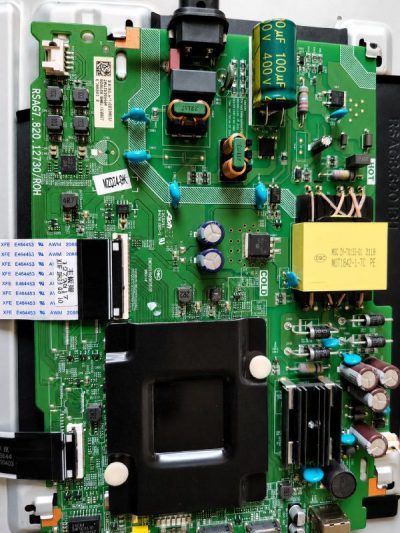
An electrolytic capacitor is a polarized capacitor that provides high capacitance in a relatively compact size. Compared with ceramic capacitors, it is better suited for handling large voltage fluctuations and temporary energy storage. Because of their high capacitance capability, they are commonly installed in power conversion systems where voltage stability is critical.
Key Advantages & Limitations
- High capacitance value relative to physical size (typically 1uF-1F)
- Cost-effective choice for power and smoothing circuits
- Excellent voltage smoothing capability
- ⚠️ Main Limitation: Polarized structure (will fail catastrophically if reversed) and a shorter operational lifespan due to liquid electrolyte evaporation over time.
Typical Applications
- Switching power supplies (SMPS) and capacitors for servers
- LED drivers and solar inverters
- Industrial motor drives
- Automotive electronics and home appliances
Note: Depending on the mounting requirements, these are available as SMD electrolytic capacitors for compact PCBs, radial types for general circuits, or snap-in/screw terminals for high-power equipment.
2. Ceramic Capacitors: Ideal for High-Frequency Decoupling and Noise Suppression
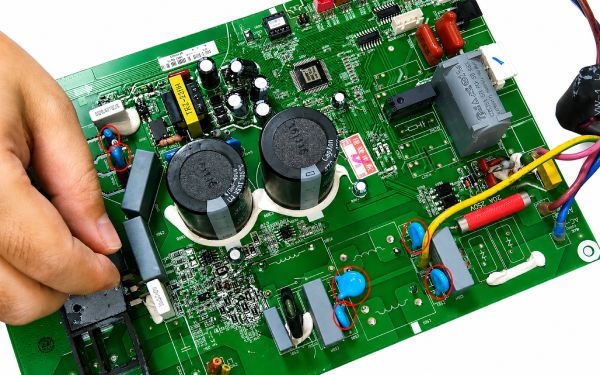
Ceramic capacitors are one of the most commonly used capacitor types in modern electronic circuits. Unlike electrolytic capacitors, which mainly focus on energy storage, ceramic capacitors are designed for high-frequency filtering, signal stability, and electrical noise suppression.
What Is a Ceramic Capacitor?
A ceramic capacitor is a non-polarized capacitor that uses ceramic material as the dielectric. It is most commonly found in the form of MLCCs (Multi-Layer Ceramic Capacitors). Because of its fast electrical response and low parasitic parameters (ESR and ESL), it is widely used in high-speed digital electronics.
Understanding Class 1 vs. Class 2 Ceramic Dielectrics
To make an accurate selection, engineers must distinguish between the two main classes of ceramic dielectrics:
- Class 1 (e.g., C0G / NP0): Offers ultra-high temperature stability and zero capacitance drift. Ideal for resonant circuits, RF filtering, and precision timing. However, capacitance values are highly limited.
- Class 2 (e.g., X7R / X5R / Y5V): Offers much higher volumetric efficiency (higher capacitance in smaller packages), but is highly sensitive to temperature changes and suffers from capacitance degradation under DC voltage.
Common Uses in Electronic Circuits
Ceramic capacitor applications are found in nearly every electronic device, especially in circuits that require fast switching or stable signal transmission.
Typical applications include:
- PCB decoupling and bypass circuits
- High-frequency filtering
- Smartphones and consumer electronics
- Computer motherboards and processors
- Automotive electronics
- Communication and RF circuits
In many designs, ceramic capacitors work together with electrolytic capacitors—electrolytic capacitors stabilize bulk power, while ceramic capacitors suppress high-frequency noise.
3. Film Capacitors: Preferred for Long-Term Stability and High-Voltage AC Circuits
Film capacitors are widely used in electronic and industrial systems where long-term stability, reliability, and consistent electrical performance are required. Among different capacitor types, film capacitors are known for their excellent electrical characteristics and long service life.
Unlike electrolytic capacitors, which are mainly used for energy storage, and ceramic capacitors, which are optimized for high-frequency performance, film capacitors are designed to deliver stable operation under high voltage and long working conditions.
What Is a Film Capacitor?
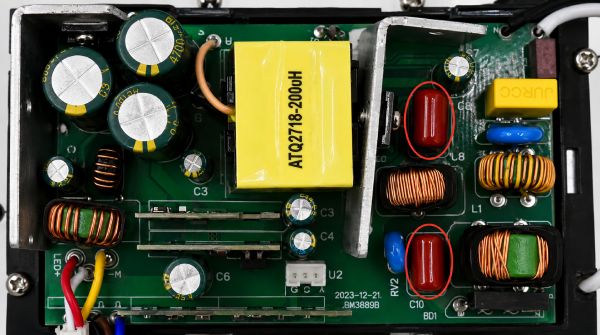
A film capacitor uses a thin plastic film (such as polypropylene or polyester) as the dielectric material. This unique structure provides high insulation resistance, ultra-low dielectric loss, and remarkably stable capacitance over a long operating life.
The Power of “Self-Healing” Properties
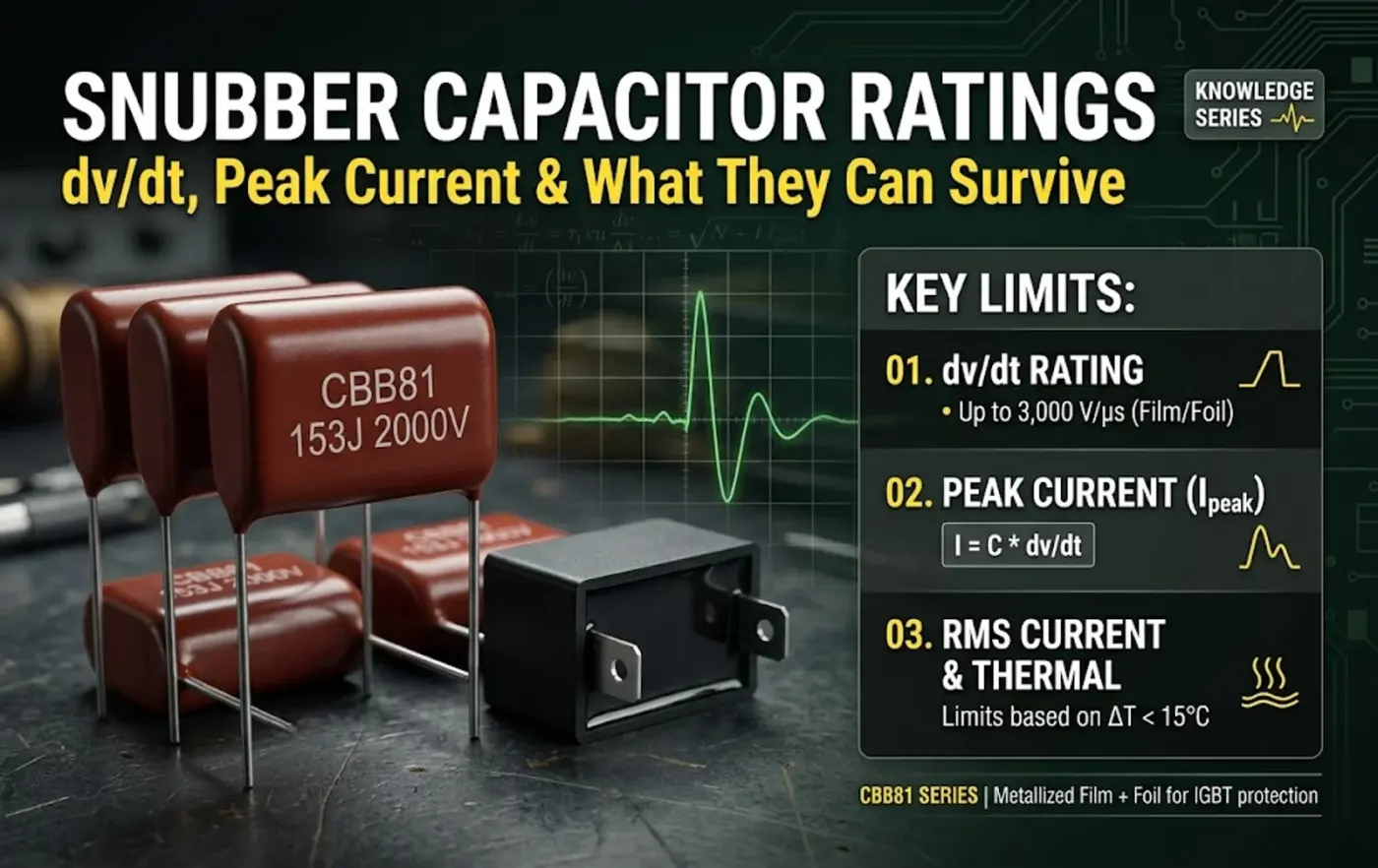
The most critical advantage of metallized film capacitors in industrial setups is their self-healing capability. If an overvoltage spike causes a localized dielectric breakdown, the thin metallic layer around the fault point instantly vaporizes due to the arc heat. This isolates the shorted area and restores the capacitor to normal operation, preventing catastrophic circuit fires.
Typical Applications of Film Capacitors
Film capacitor uses are mainly found in medium to high-power and high-reliability applications, especially where electrical stress is significant.
Common film capacitor uses include:
- Motor drive and inverter systems
- Industrial power supplies
- Renewable energy systems (solar and wind)
- AC filtering and power conditioning
- Automotive electronics
- Audio and precision circuits
In many industrial designs, film capacitors are used to improve system stability and reduce long-term failure risk, especially in high-voltage environments.
Compared with other capacitor types, film capacitors are often selected when reliability and lifespan are more important than component size.
4. Tantalum Capacitors
Tantalum capacitors are widely used in compact electronic devices where stable capacitance and small component size are required. Among different capacitor types, they are valued for their high capacitance density and reliable electrical performance in space-limited circuit designs.
Compared with electrolytic and ceramic capacitors, tantalum capacitors offer more stable capacitance characteristics, making them suitable for applications that require consistent performance over time.
Advantages of Tantalum Capacitors
✔ High capacitance in a very small package
✔ Stable electrical performance
✔ Good reliability in low-voltage DC circuits
✔ Suitable for compact PCB designs
However, tantalum capacitors are also more sensitive to voltage and surge current, which means proper circuit design and protection are required to ensure safe operation.
Typical Applications
Tantalum capacitor applications are mainly found in:
- Smartphones and portable electronics
- Medical electronic devices
- Compact control modules
- Power management circuits
- Low-voltage DC filtering systems
Due to their size advantage, tantalum capacitors are often selected when PCB space is limited and stable capacitance is required.
5.Supercapacitors
Supercapacitors, also known as ultracapacitors, are energy storage devices that bridge the gap between traditional capacitors and batteries. Among different capacitor types, they are known for their extremely high capacitance and ability to deliver fast energy bursts.
Unlike other capacitor types used for filtering or signal stability, supercapacitors are mainly designed for energy storage applications that require rapid charge and discharge cycles.
What Is a Supercapacitor?
Unlike other capacitor types used for high-frequency filtering, supercapacitors utilize electrochemical double-layer capacitance to achieve immense capacitance values (measured in Farads, 1F-3000F). They are designed for rapid charge and discharge cycles rather than steady-state power conditioning.
Key Advantages & Limitations
- Virtually unlimited cycle life (100,000+cycles) with minimal degradation compared to chemical batteries.
- ⚠️ Main Limitation: Very low voltage rating per single cell (typically 2.5V- 3.0V), requiring series connections and cell-balancing circuits for higher voltage systems.
Typical Applications
Supercapacitor applications are mainly found in systems that require short-term energy backup or rapid power delivery, such as:
- Backup power systems
- Smart meters and industrial memory backup
- Renewable energy storage support
- Automotive start-stop systems
- Power stabilization modules
Because of their unique energy behavior, supercapacitors are often used alongside batteries rather than replacing them completely.
6.Feedthrough Capacitors: Optimized for EMI Suppression and Signal Integrity
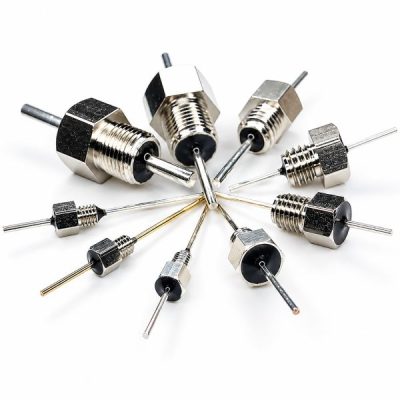
Feedthrough capacitors are specialized components designed for electromagnetic interference (EMI) suppression in high-frequency and high-reliability electronic systems. Among different capacitor types, they are specifically engineered to filter unwanted noise while allowing DC or low-frequency signals to pass through.
Unlike general-purpose capacitors used for energy storage or signal decoupling, feedthrough capacitors are typically integrated into metal housings or feedthrough structures to achieve superior high-frequency noise suppression performance.
What Makes Feedthrough Capacitors Different?
Feedthrough capacitors are designed with a unique structure that minimizes parasitic inductance, allowing them to perform effectively at very high frequencies. This makes them more efficient than standard capacitors when dealing with EMI in sensitive electronic environments.
They are often used in systems where signal integrity and electromagnetic compatibility (EMC) are critical.
Advantages of Feedthrough Capacitors
✔ Excellent high-frequency EMI suppression
✔ Low parasitic inductance design
✔ High reliability in harsh environments
✔ Effective noise filtering in compact structures
Because of these characteristics, feedthrough capacitors are widely used in demanding industrial and electronic systems where standard capacitors cannot provide sufficient noise control.
Typical Applications
Feedthrough capacitor applications are mainly found in systems requiring strong EMI protection, including:
- Industrial power supplies
- EMI/EMC filter modules
- Medical electronic equipment
- Automotive electronic control systems
- Communication and signal processing systems
- High-reliability military and aerospace electronics
In many EMI filter designs, feedthrough capacitors are used together with inductors and other filtering components to form complete noise suppression solutions.
7. Safety Capacitors
Safety capacitors are specially designed components used in AC power systems where electrical safety and reliability are critical. Among different capacitor types, they are built to meet strict international safety standards for operation directly connected to the mains power supply.
Unlike standard capacitors used for signal processing or energy storage, safety capacitors are designed to fail in a controlled and safe manner, helping prevent electrical hazards in AC circuits.
Types of Safety Capacitors
Safety capacitors are placed directly across AC mains power lines and are divided into two categories:
- X Capacitors (Line-to-Neutral): Used to suppress differential-mode noise. If they fail, they safely short-circuit, blowing the circuit fuse.
- Y Capacitors (Line-to-Ground): Used to reduce common-mode noise. They are engineered to fail open-circuit to prevent dangerous electrical shocks from passing to the metallic chassis touched by humans.
Both types are essential for improving electromagnetic compatibility (EMC) in AC power systems.
Advantages of Safety Capacitors
✔ Designed for high safety and reliability standards
✔ Certified for direct AC line applications
✔ Effective EMI and noise suppression
✔ Stable performance under high voltage conditions
Because of these characteristics, safety capacitors are mandatory in many power electronics products that connect directly to AC mains.
Typical Applications
Safety capacitor applications are widely found in:
- AC power supplies
- Home appliances
- Industrial power equipment
- Charging devices
- LED lighting drivers
- Consumer electronics
They are an essential part of EMI filter circuits, ensuring both device performance and user safety in AC-powered systems.
Quick Comparison of Common Capacitor Types
The table below provides a quick comparison of the most common capacitor types used in modern electronics.
| Capacitor Types | Primary Function | Key Advantage | Main Limitation | Typical Applications |
|---|---|---|---|---|
| Electrolytic Capacitor | Energy storage & voltage smoothing | High capacitance | Polarized, shorter lifespan | Power supplies, inverters, LED drivers |
| Ceramic Capacitor | High-frequency filtering | Small size & fast response | Limited capacitance | PCB circuits, decoupling, RF circuits |
| Film Capacitor | Stable voltage control | Long lifespan & reliability | Larger physical size | Motor drives, industrial electronics |
| Tantalum Capacitor | Compact energy buffering | Stable capacitance | Sensitive to overvoltage | Consumer electronics, compact PCBs |
| Supercapacitor | Short-term energy storage | Fast charge/discharge | Low voltage rating | Backup power, energy storage |
| Feedthrough Capacitor | EMI noise suppression | Excellent high-frequency filtering | Specialized application | EMI filters, industrial equipment |
| Safety Capacitor | Electrical protection in AC circuits | High safety compliance | Limited usage scenarios | Home appliances, AC filtering |
From this comparison, it becomes clear that there is no universal capacitor suitable for every circuit. For example, if a design requires high capacitance and ripple current handling, electrolytic capacitors are usually preferred. When high-frequency noise suppression is critical, ceramic or feedthrough capacitors often provide better performance. For applications demanding long-term stability, film capacitors are generally a more reliable option.
In practice, engineers frequently combine multiple capacitor types in one circuit to balance energy storage, filtering efficiency, reliability, and EMI control.
Frequently Asked Questions (FAQ) about Capacitor Types
What are the 7 main types of capacitors used in electronics?
The 7 most common capacitor types are electrolytic, ceramic, film, tantalum, supercapacitor, feedthrough, and safety capacitors. Each serves a dedicated role in circuits, ranging from bulk energy storage to high-frequency electromagnetic noise filtering.
Electrolytic vs. Ceramic Capacitor: What is the difference?
The key difference lies in their application focus. Electrolytic capacitors are polarized and deliver high capacitance, making them perfect for low-frequency power smoothing. Ceramic capacitors are non-polarized, smaller, and have much lower parasitic values, making them ideal for high-frequency decoupling and noise suppression.
Which capacitor type is best for power supply applications?
For power supplies, engineers typically use a combination of electrolytic and ceramic capacitors. Electrolytic capacitors act as bulk reservoirs to absorb low-frequency voltage ripples, while ceramic capacitors sit close to integrated circuits to filter out high-frequency switching noise.
Why use a feedthrough capacitor instead of a standard ceramic capacitor?
Standard capacitors have lead wires or SMD terminations that introduce parasitic inductance, which reduces their filtering capability at high frequencies. Feedthrough capacitors feature a coaxial design that eliminates this inductance, allowing superior EMI filtering up into the gigahertz ($\text{GHz}$) range.
The 7 most common capacitor types are electrolytic, ceramic, film, tantalum, supercapacitor, feedthrough, and safety capacitors. Each serves a dedicated role in circuits, ranging from bulk energy storage to high-frequency electromagnetic noise filtering.
Electrolytic vs. Ceramic Capacitor: What is the difference?
The key difference lies in their application focus. Electrolytic capacitors are polarized and deliver high capacitance, making them perfect for low-frequency power smoothing. Ceramic capacitors are non-polarized, smaller, and have much lower parasitic values, making them ideal for high-frequency decoupling and noise suppression.
Which capacitor type is best for power supply applications?
For power supplies, engineers typically use a combination of electrolytic and ceramic capacitors. Electrolytic capacitors act as bulk reservoirs to absorb low-frequency voltage ripples, while ceramic capacitors sit close to integrated circuits to filter out high-frequency switching noise.
Why use a feedthrough capacitor instead of a standard ceramic capacitor?
Standard capacitors have lead wires or SMD terminations that introduce parasitic inductance, which reduces their filtering capability at high frequencies. Feedthrough capacitors feature a coaxial design that eliminates this inductance, allowing superior EMI filtering up into the gigahertz ($\text{GHz}$) range.
Conclusion
Understanding the different capacitor types is essential for designing reliable and efficient electronic circuits. Each type of capacitor serves a specific role: electrolytic capacitors are commonly used for energy storage and voltage smoothing, ceramic capacitors are ideal for high-frequency filtering and signal decoupling, while film capacitors provide long-term stability and performance in high-voltage applications.
Other capacitor types, such as tantalum capacitors, supercapacitors, feedthrough capacitors, and safety capacitors, further extend the range of design possibilities for compact electronics, energy storage systems, EMI suppression, and AC power protection.
In real-world applications, there is no single best capacitor type. The selection depends on circuit requirements, operating conditions, cost considerations, and reliability targets. Most electronic systems use a combination of different capacitor types to achieve optimal performance in power stability, noise reduction, and electromagnetic compatibility.
By understanding the characteristics and applications of common capacitor types, engineers and buyers can make more informed decisions and choose the most suitable components for their specific designs.