What Is a CBB Capacitor?
A CBB capacitor is a metallized polypropylene film capacitor — a non-polarized capacitor that uses polypropylene film as the dielectric and an ultra-thin metallized layer (aluminum or zinc-aluminum alloy) deposited by vacuum evaporation as the electrode. In the Chinese naming convention, C stands for Capacitor and BB stands for polypropylene (polypropylene film dielectric with a metallized electrode).
CBB capacitors are among the most widely used film capacitors in AC and DC circuits that need low loss, stable capacitance over temperature and frequency, and self-healing capability — from LED drivers and household appliance control boards to motor run/start circuits and high-frequency power electronics.
How Does a CBB Capacitor Work?
Like every capacitor, a CBB capacitor stores electrical energy in the electrostatic field between two electrodes separated by a dielectric. In a CBB capacitor the polypropylene film is wound into a compact, non-inductive structure, and the thin metallized coating on the film acts as the electrode.
The most important working characteristic is self-healing. When a localized breakdown occurs, the metallized layer around the fault point evaporates instantly and isolates the fault automatically, so the capacitor keeps working instead of short-circuiting immediately. This self-healing property, combined with extremely low dielectric loss, is why CBB capacitors survive voltage spikes and high-frequency ripple far better than electrolytic types.
CBB Capacitor Naming and Marking Rules
Understanding the model number is the first step to choosing the right part. The letters give the dielectric, and the last digit of the series number gives the voltage class and construction:
- C = Capacitor
- BB = polypropylene film dielectric with metallized electrode
- Last digit 0 = axial leads; 1 = radial leads (DC)
- Last digit 2 = DC voltage rating (general purpose)
- Last digit 6 = AC voltage rating (motor capacitors)
- Last digit 8 = DC high voltage
For example, a marking such as 105J/400V reads as 1.0 µF (105 = 10 × 105 pF), tolerance ±5% (J), rated 400 V DC.
CBB Series Explained
CBB is not a single part but a family of series. The table below summarizes the five series you will meet most often in purchasing:
| Series | Construction | Typical Voltage | Main Applications |
|---|---|---|---|
| CBB21 | Metallized polypropylene, rectangular resin (flame-retardant epoxy) encapsulation, radial leads | DC 63 V – 630 V | General DC circuits, LED power supplies, energy-saving lamps, electronic ballasts |
| CBB22 | Improved metallized polypropylene, rectangular resin encapsulation | DC 250 V – 630 V typical | High-current and high-frequency circuits, household appliances, coupling and filtering |
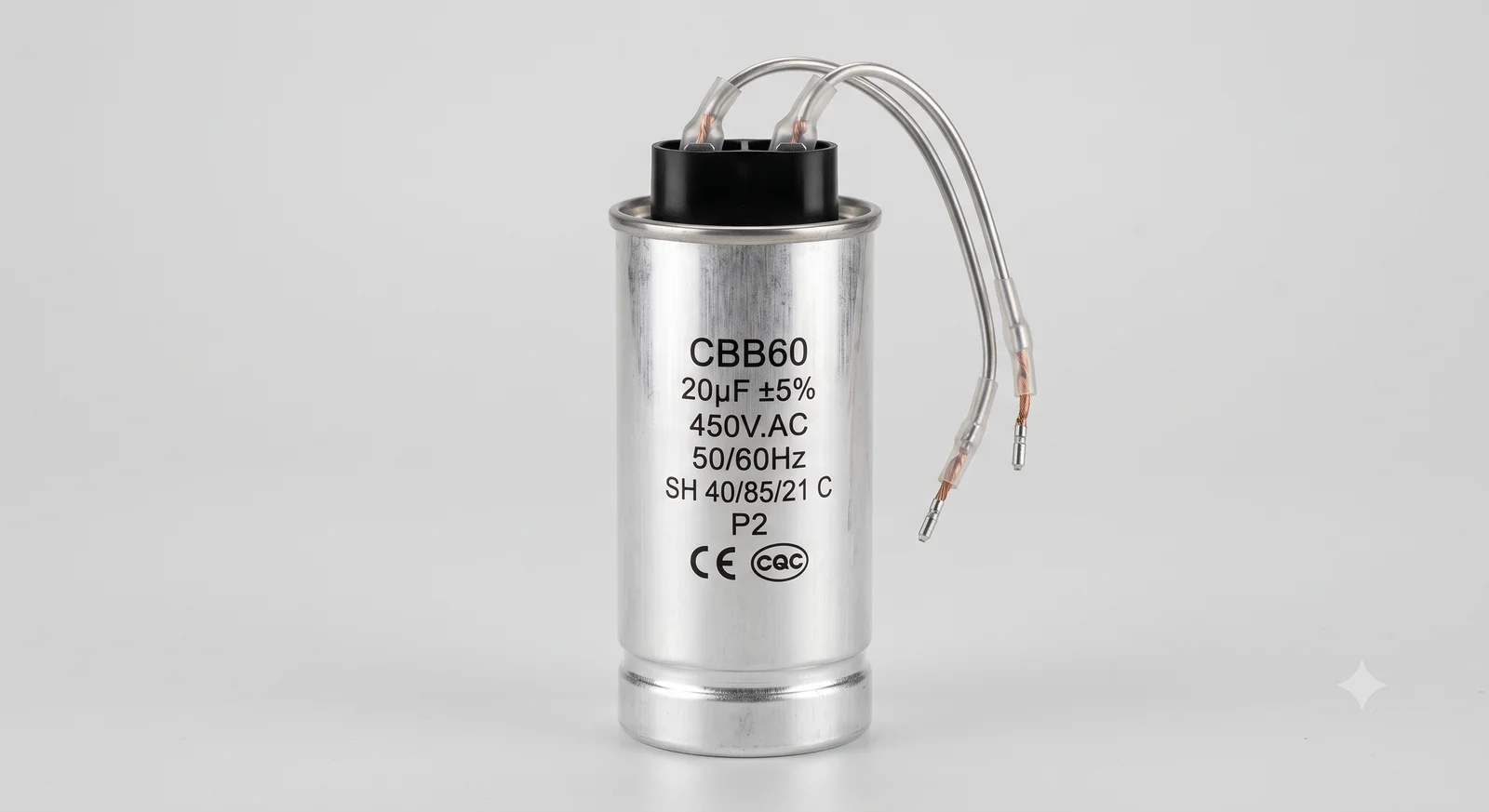
| CBB60 | Cylindrical aluminum shell, explosion-proof, bolt or insert leads | AC 250 V – 500 V | AC motor run/start — water pumps, compressors, washing machines, range hoods |
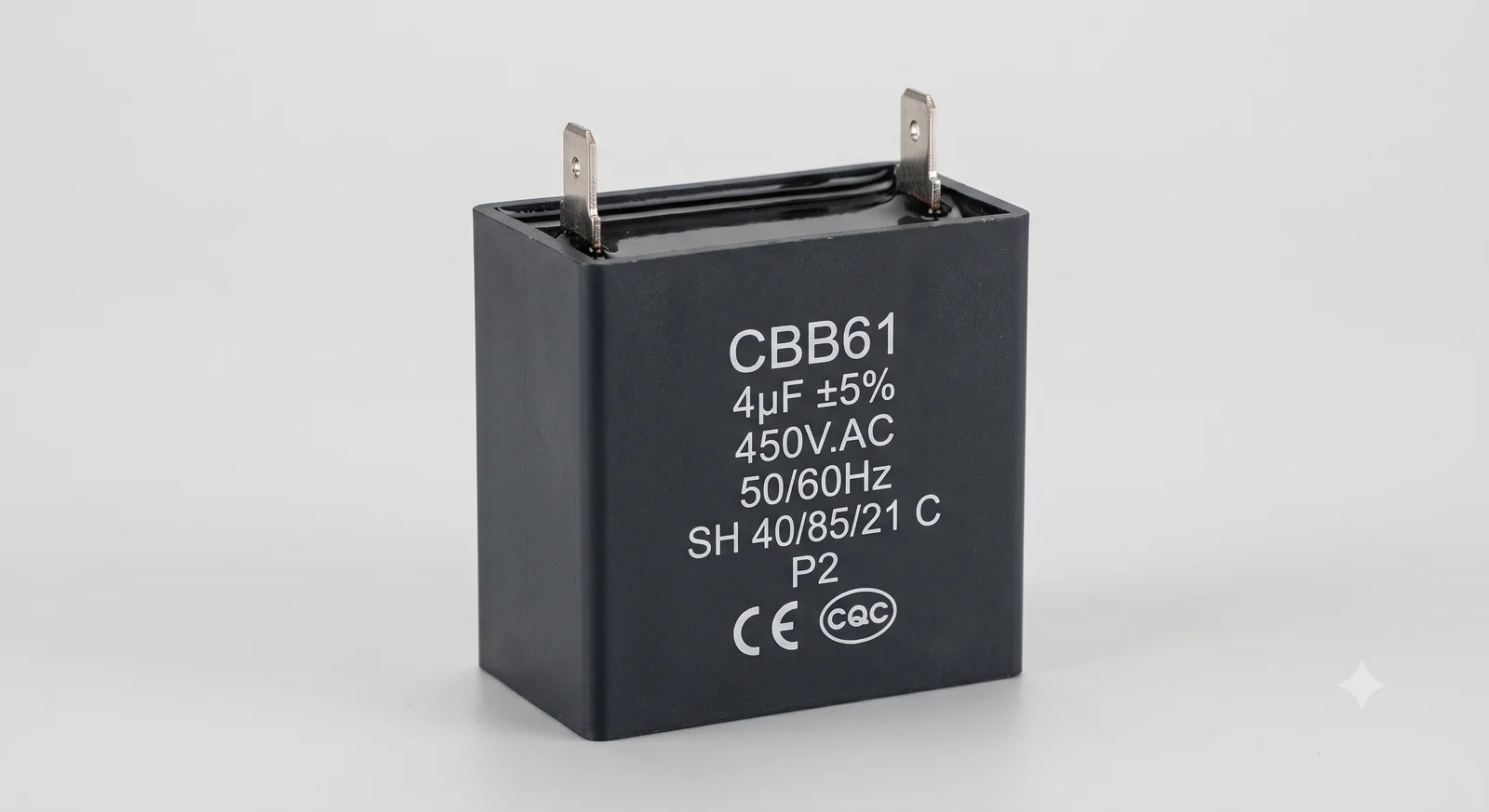
| CBB61 | Square flame-retardant plastic shell, laterally led-out pins | AC 250 V – 630 V | Single-phase motor starting — electric fans, air-conditioner fans, fan speed controllers |
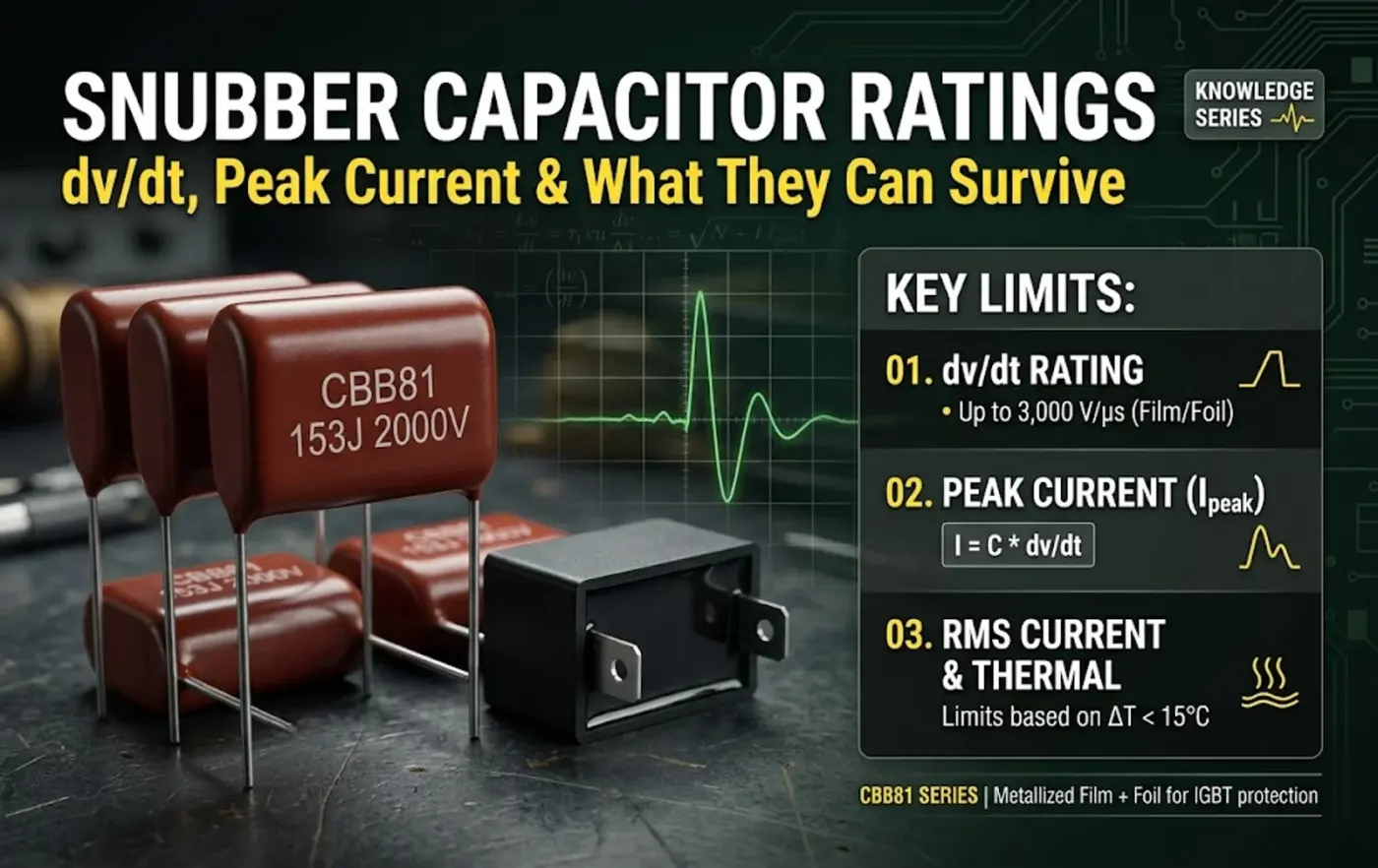
| CBB81 | High-voltage metallized foil, high-pressure resin encapsulation with series-connected film layers | DC 1 kV – 2 kV | TV S-correction, induction-cooker resonant circuits, ballasts, contactor arc suppression |
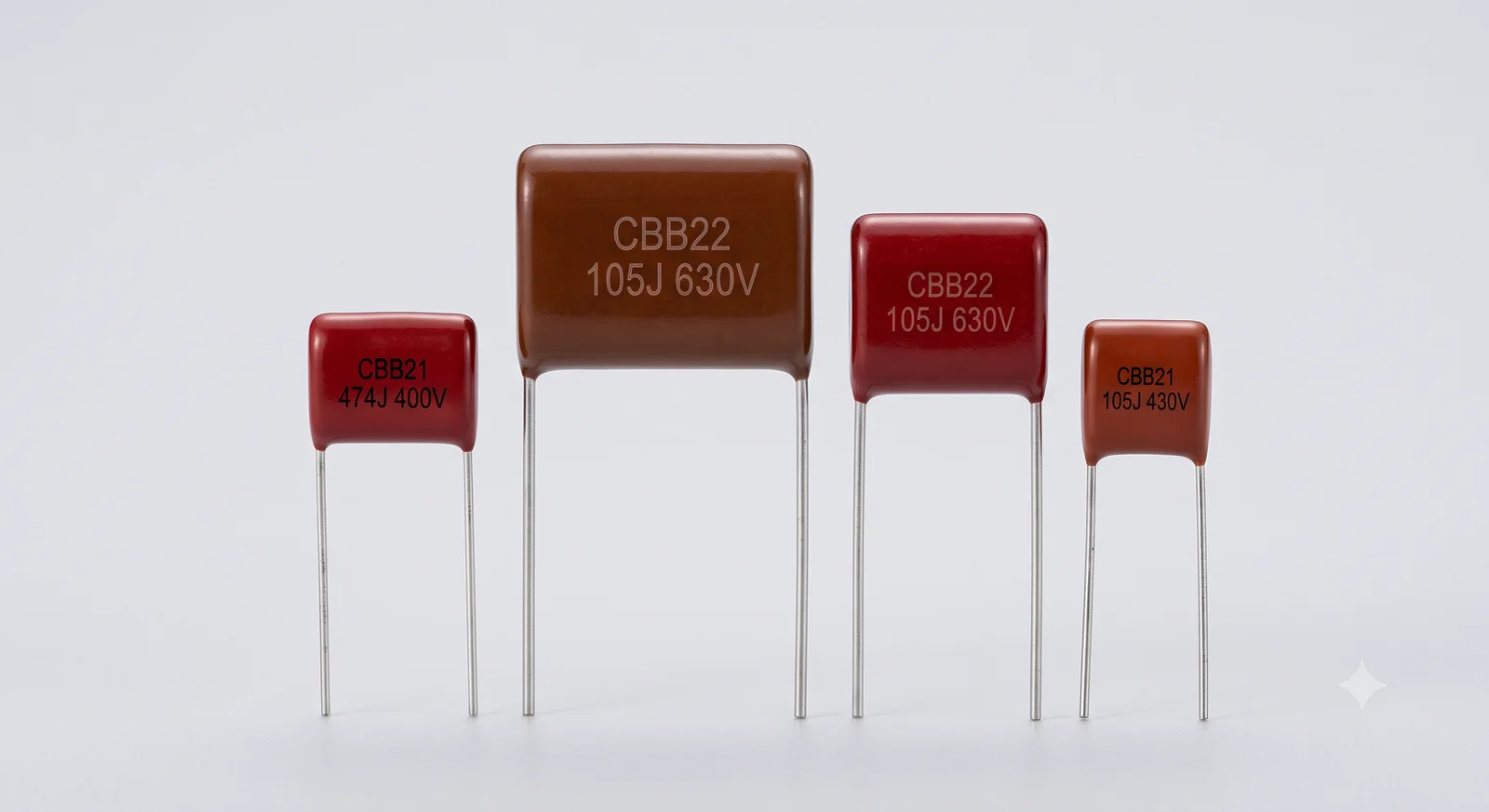
You can browse our ready-to-ship ranges for CBB21 film capacitors, CBB22 film capacitors, CBB61 motor capacitors and CBB81 high-voltage capacitors.
CBB21 vs CBB22: What’s the Difference?
Today CBB21 and CBB22 are essentially the same type of part. CBB22 is the improved designation that became common after film and winding technology advanced — same metallized polypropylene dielectric, same radial-lead rectangular epoxy encapsulation, but with better consistency for higher-current and higher-frequency circuits. In most new designs and replacement orders, CBB22 is the safer default. CBB21 remains available for applications that still specify it and is often interchangeable with CBB22 at the same capacitance and voltage rating.
CBB60 vs CBB61: Motor Run and Start Capacitors
Both are AC motor capacitors, but they are built differently for different duty.
- CBB60 uses a cylindrical aluminum shell with an explosion-proof design. The metal case gives excellent heat dissipation and vibration resistance, so it suits continuously operating motors — water pumps, compressors, washing machines and range hoods. It is typically secured with a bolt or insert leads.
- CBB61 uses a square flame-retardant plastic shell with laterally led-out pins. The sealed plastic case offers strong moisture resistance and mechanical strength with a long rated life (for example 105 °C / 5000 hours in quality grades), which fits fan motors — electric fans, air-conditioner fans and fan speed controllers.
Both are used in single-phase capacitor-run asynchronous motors at 50/60 Hz. A run capacitor stays permanently connected to improve the power factor; a start capacitor is switched in only during starting.
Key Parameters of CBB Capacitors
- Capacitance range: typically 1000 pF – 10 µF depending on series.
- Rated voltage: DC types 63 V – 2000 V (common 250 V / 400 V / 630 V); AC motor types 250 V – 630 V.
- Tolerance: ±5% (J), ±10% (K), ±20% (M).
- Dissipation factor (loss): extremely low — down to 0.0008 in quality parts.
- Insulation resistance: high, owing to the polypropylene dielectric.
- Operating temperature: −40 °C to +85 °C standard; +105 °C for high-temperature grades.
- Polarity: non-polarized, so CBB capacitors can be used in either direction in AC and DC circuits.
CBB Capacitor Applications
- LED drivers and power filtering — CBB21/CBB22, e.g. 105J 400 V.
- Household appliance control circuits — CBB21/CBB22.
- Motor run/start — CBB60/CBB61 for pumps, compressors, fans, air conditioners, washing machines, range hoods.
- High-frequency and high-current circuits — electronic ballasts, energy-saving lamps, CBB21/CBB22.
- High-voltage resonance — induction cookers, TV S-correction, contactor arc suppression, CBB81.
- DC-Link and snubber in inverters and power converters — dedicated film capacitor ranges.
For EMI suppression where a safety-rated part is mandatory, use X2 / X safety capacitors rather than a general-purpose CBB22.
CBB vs CL and X2 (MKP) Capacitors
CBB vs CL (polyester): CBB polypropylene capacitors have lower dielectric loss and better stability of capacitance across temperature and frequency than CL polyester types, so CBB is preferred in high-frequency and precision circuits. CL remains a lower-cost option where the requirements are relaxed.
CBB vs X2/MKP safety capacitors: MKP is the Taiwan/Korea series name; in mainland China the safety-certified equivalent is CBB19. A certified X2 safety capacitor is rated 250/275 V AC with a 2000 V DC withstand (2 s), whereas a general CBB22 is not safety-certified and withstands about 1.6 × its rated voltage. Choose X2/Y where an EMI-suppression or safety approval is required; choose CBB22 where the application is a standard DC or AC circuit without such certification, at lower cost.
CBB Capacitor Selection Guide
- Identify the circuit: AC or DC, operating frequency, ripple or pulse current.
- Set the voltage rating: choose at least 1.5 – 2 × the peak working voltage; for high-voltage applications derate by about 1.5 ×.
- Choose capacitance and tolerance from the circuit requirement (e.g. 1 µF, ±5%).
- Pick the construction: rectangular resin encapsulation (CBB21/22), aluminum shell (CBB60) or plastic shell (CBB61), high-voltage (CBB81).
- Check the environment: temperature, humidity and vibration — sealed plastic and metal shells resist moisture better than resin encapsulation.
- Confirm certification needs: use X2/Y for EMI-suppression and safety approvals.
- Ask the factory for samples and a datasheet before volume ordering.
Common Failure Modes and Reliability
- Overvoltage breakdown: repeated spikes beyond the rated voltage eventually exhaust the self-healing margin.
- Self-heating under high-frequency, high-current: residual loss raises internal temperature; keep ripple current within the rating.
- Humidity and temperature: resin-encapsulated types are less moisture-resistant than sealed plastic or metal shells, which matters in damp or hot enclosures.
- Ageing: capacitance drift and insulation degradation over many years at high temperature.
How to Test a CBB Capacitor
Check capacitance and insulation with a multimeter or LCR meter, measure dissipation factor (ESR/tan δ) with an LCR bridge, and inspect the case for bulging or cracks. For high-voltage series such as CBB81, test the withstand voltage only within the rated spec and with proper safety precautions.
FAQ
Is a CBB capacitor polarized? No — CBB capacitors are non-polarized and work in either direction.
Are CBB21 and CBB22 the same? Essentially yes; CBB22 is the improved designation of the same metallized polypropylene type.
Can I use a CBB60 in place of CBB61? Only if the capacitance, voltage and duty match — the shell and terminals differ, so check mounting and the run/start duty first.
Can CBB capacitors be used on AC? Yes, CBB60 and CBB61 are designed for AC motor circuits; CBB21/22 are primarily for DC.
Why can’t CBB81 be replaced with a normal CBB21? CBB81 is built to withstand high-voltage pulses (1–2 kV); a general CBB21 does not have the same withstand margin.
Need Help Choosing a CBB Capacitor?
Xuansn Capacitor is a film capacitor manufacturer supplying the full CBB family — film capacitor range — factory-direct with samples and datasheets. Send us your circuit conditions and we will recommend the right series, voltage and package.