Open any box of used power supplies and you will find the same green rectangular part stamped with a code like 2J105J. The CBB22 capacitor value printed on its side is not a random factory reference . It is an EIA standard marking, and the same three-digit pattern decodes every part in the series. This guide walks you through reading that code, provides a reference chart of the values you will actually encounter, and covers the ratings that decide whether the part lasts in your circuit. If you are new to film capacitors, the broader film capacitor selection guide explains the whole family first.
What the printed code on a CBB22 actually means
Physically, a CBB22 is a metallized polypropylene film capacitor, the workhorse radial film part found across consumer power electronics, LED drivers and switching power supplies. Its marking carries three pieces of information: a three-digit capacitance code, a one-letter tolerance code, and often a voltage prefix such as 2G or 2J.
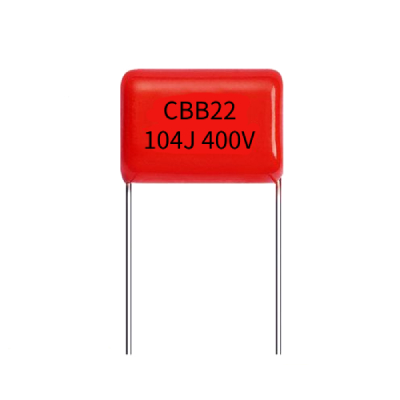
The capacitance code works like this. The first two digits are the significant figures, the third digit is the number of zeros to add, and the result is in picofarads (pF). The trailing letter is the tolerance: J means ±5%, K means ±10%, M means ±20%.
Apply that to the two codes you will see most often. 105J is 10 plus five zeros = 1,000,000 pF = 1.0 µF. 474J is 47 plus four zeros = 470,000 pF = 0.47 µF. Both at ±5% tolerance.
| Code | Math | Value (pF) | Value (µF) |
|---|---|---|---|
| 104J | 10 × 104 | 100,000 | 0.1 |
| 224J | 22 × 104 | 220,000 | 0.22 |
| 334J | 33 × 104 | 330,000 | 0.33 |
| 474J | 47 × 104 | 470,000 | 0.47 |
| 684J | 68 × 104 | 680,000 | 0.68 |
| 105J | 10 × 105 | 1,000,000 | 1.0 |
The system has two edge cases worth knowing. When the third digit is 0, no zeros are added, so 100 is simply 10 pF and 101 is 100 pF. Both are rare on CBB22 parts, which usually start at 1 nF. And a leading letter is never a capacitance digit: 2G and 2J are voltage prefixes, so 2G104J reads as 400V 0.1 µF, not as a five-figure capacitance code.
CBB22 value chart: common codes at a glance
You will rarely meet codes below 101 on a CBB22, because values under 100 pF are normally built as ceramic parts. The codes below cover the range you will actually find, from small coupling parts to the 1 µF and 2.2 µF units used in LED drivers and ballasts.
| Code | Value (pF) | Value (nF) | Value (µF) | Common voltage ratings |
|---|---|---|---|---|
| 102 | 1,000 | 1 | 0.001 | 250V / 400V / 630V |
| 103 | 10,000 | 10 | 0.01 | 250V / 400V / 630V |
| 104 | 100,000 | 100 | 0.1 | 250V / 400V / 630V |
| 105 | 1,000,000 | 1,000 | 1.0 | 250V / 400V |
| 223 | 22,000 | 22 | 0.022 | 400V / 630V |
| 224 | 220,000 | 220 | 0.22 | 400V / 630V |
| 225 | 2,200,000 | 2,200 | 2.2 | 250V / 400V |
| 333 | 33,000 | 33 | 0.033 | 400V / 630V |
| 334 | 330,000 | 330 | 0.33 | 400V / 630V |
| 473 | 47,000 | 47 | 0.047 | 250V / 400V |
| 474 | 470,000 | 470 | 0.47 | 400V / 630V |
| 475 | 4,700,000 | 4,700 | 4.7 | 250V / 400V |
| 684 | 680,000 | 680 | 0.68 | 400V / 630V |
A note on the chart: the same code means the same capacitance on any manufacturer’s part. That is the point of the EIA system. What changes between brands is the body size for a given voltage, so treat the last column as indicative.
Voltage, tolerance and temperature: the second half of the code
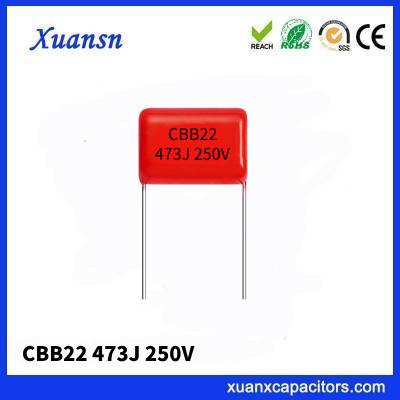
Capacitance alone does not tell you whether the part is safe to install. When the marking includes a letter-digit voltage prefix, it follows the IEC voltage code.
| Prefix | Rated DC voltage | Prefix | Rated DC voltage |
|---|---|---|---|
| 2A | 100V | 2F | 315V |
| 2B | 125V | 2G | 400V |
| 2C | 160V | 2H | 500V |
| 2D | 200V | 2J | 630V |
| 2E | 250V | 3A | 1000V |
So 2G105J means 400V DC, 1.0 µF, ±5%, while 2J105J means 630V DC, 1.0 µF. A 630V part and a 400V part can carry the same capacitance value; the voltage rating is what changes the body size.
Temperature behaviour matters for derating. A typical CBB22 is rated at +85°C and operates from -40°C to +105°C; above +85°C, manufacturers recommend reducing the working voltage by about 1.25% per degree up to the +105°C limit.
CBB22 capacitors are non-polarised, so there is no correct mounting direction. That is one reason they replace electrolytic types in AC-coupled audio and signal paths, where polarity would be a problem.
Beyond the value: ratings that decide the right part
Choosing a CBB22 is not only matching the number of microfarads. Three further ratings separate a part that works from one that fails early.
Loss. The dissipation factor is typically no higher than 10 × 10-4 at 1 kHz for units up to 1 µF, which is why polypropylene beats polyester in high-frequency paths.
Insulation resistance. A typical part up to 0.33 µF offers at least 60,000 MΩ at 20°C, and larger values are specified by time constant rather than absolute resistance.
Pulse strength. Metallized polypropylene handles steep voltage edges well; at 400V, a common 7.5mm pitch part sustains roughly 900 V/µs dV/dt, while larger 22.5mm parts drop to around 300 V/µs. If your circuit switches hard, choose a part rated for that pulse.
The same metallized construction gives CBB22 capacitors self-healing behaviour: a local dielectric breakdown burns away a tiny metallized area instead of shorting the part. Pin pitch (5 / 7.5 / 10 / 15 / 20 mm) is the last practical constraint: it must match your PCB holes.
When a part has failed and you need to confirm the reading, the measurement steps in how to test capacitors apply directly to film types. For current production parts, the CBB22 film capacitor range lists available values, and the CBB22 225J400V capacitor page shows a 2.2 µF example.
CBB22 vs CBB21: what the series name tells you
CBB21 and CBB22 share the same polypropylene dielectric, and many manufacturers treat them as one series with two case styles rather than two different technologies. Do not decide a replacement from the series name alone. The printed voltage and capacitance codes are the only reliable comparison. The wider picture of the family is covered in the CBB capacitor types guide.
Replacing a failed CBB22: the four numbers to match
When a capacitor on a PCB has failed and you are picking a replacement, four values on the old body decide the swap. Match the capacitance code exactly, then check the voltage prefix and never drop below the original rating. A higher voltage part is always safe. Match the tolerance for anything in a timing or filter role; for a simple bypass duty, a K or M part is often acceptable. Finally, measure the lead pitch against the PCB holes, because a 7.5mm part will not sit on a 10mm footprint even if every electrical value matches.
FAQ
Is a CBB22 capacitor polarised? No. It is a non-polarised film part and can be installed in either direction, which makes it a natural fit for AC-coupling and crossover duties.
Can I use a CBB22 as an X2 safety capacitor? No. A CBB22 is not a certified safety capacitor. Across the AC mains you need a part with an X2 or Y2 safety certification; substituting a standard film capacitor for that role is unsafe.
Can I replace 105J400V with 105J630V? Yes for the capacitance value. The 630V part has more voltage headroom and a larger body; keep the same value and tolerance, and match or exceed the original voltage rating.
Why does my meter read a different value than the code? Tolerance alone allows ±5%, and meter leads and measurement frequency add error. A reading within a few percent of the code is normal; a part far outside it is suspect.
Need CBB22 values in production volume? Xuansn supplies metallized polypropylene film capacitors from 0.001 µF to 3.3 µF at 100V to 2000V with ±5% tolerance. Send your required code and quantity for a quote.