uF stands for microfarad, and it is the capacitance value printed on most capacitors. If you can read the markings on a capacitor, you can match a replacement, check a suspect part, or order the right component without guessing. This guide walks through the markings you will actually see in the hand: the uF, nF and pF units, the older MFD label, the three-digit codes on ceramics, the letters used for tolerance and voltage on film capacitors, and how to tell whether a part is polarized.
What uF Actually Means
A microfarad is one millionth of a farad, written as 1 µF = 1 × 10⁻⁶ F. In practical circuits a uF is a large unit: values in the microfarad range appear in power supply filtering, energy buffering, motor run capacitors and DC-link banks, while signal and high frequency work usually needs nanofarads or picofarads.
The larger the uF value, the more charge the capacitor holds at a given voltage. That is why a 470 uF part smooths a supply rail that a 100 pF part would ignore entirely.
uF, nF, pF and MFD: Which Unit You Are Looking At
Four labels turn up for the same physical quantity, and the confusion between them causes more wrong replacements than any other marking on a capacitor.
| Marking | Full name | Value |
|---|---|---|
| uF / µF | Microfarad | 10−6 F |
| nF | Nanofarad | 10−9 F |
| pF | Picofarad | 10−12 F |
| MFD | Microfarad (older label) | same as uF |
The units step by a factor of 1000: 1 uF = 1000 nF = 1,000,000 pF. MFD is not a different unit at all. It is the same microfarad, spelled out because the Greek letter µ was difficult to print legibly on small components. MFD still shows up on motor run capacitors, air conditioning parts and vintage equipment, and it should always be read as uF when you are matching a replacement.
How to Read the Markings on a Film Capacitor
Film capacitors pack three pieces of information into a short string: the capacitance code, a tolerance letter, and a voltage code. A marking such as 2A104J reads as follows.
The string carries three separate pieces of information. The leading 2A is the DC voltage code and resolves to 100 V. The middle three digits, 104, are the capacitance code, equal to 100 nF or 0.1 µF. The final letter gives the tolerance, and J means ±5%.
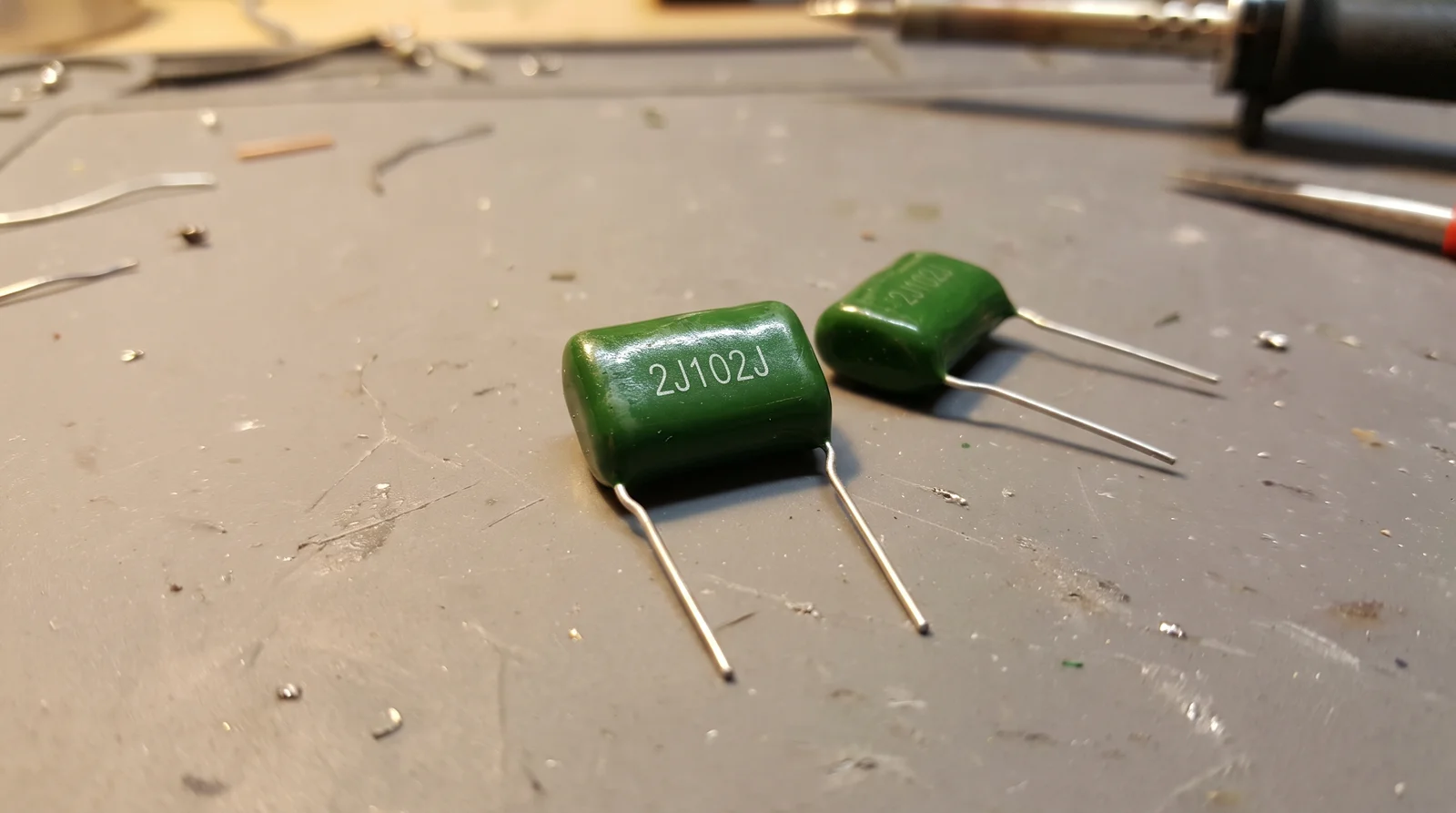
The capacitance code works the same way as the ceramic code covered below: two significant digits followed by the number of zeros, in picofarads. So 104 is 10 followed by four zeros, or 100,000 pF. The tolerance letter is the standard series: J for ±5%, K for ±10%, M for ±20%.
The voltage code is the part most people have not been taught. It is a digit plus a letter: the digit is the multiplier and the letter is the significant value.
| Code | DC voltage | Code | DC voltage |
|---|---|---|---|
| 1H | 50 V | 2G | 400 V |
| 1J | 63 V | 2W | 450 V |
| 2A | 100 V | 2J | 630 V |
| 2E | 250 V | 3A | 1000 V |
The letter values are A = 1.0, E = 2.5, G = 4.0, H = 5.0, J = 6.3 and W = 4.5, and the leading digit sets the power of ten: 1 means ×10, 2 means ×100, 3 means ×1000. That is why 2J works out to 6.3 × 100 = 630 V. Once the pattern clicks, a marking like 2J103J reads immediately as a 630 V, 10 nF, ±5% part.
Larger film capacitors often skip the voltage code and print the rating directly, as in 474K 400V, which is 0.47 µF, ±10%, 400 V. Both styles appear on the same production line, so check which one you are holding before you read the number.
Three-Digit Codes on Ceramic Capacitors
Small ceramic discs and MLCCs rarely have room for a full value, so they use a three-digit code in picofarads. The first two digits are the significant figures and the third is the number of zeros to add.
| Code | Working | Result |
|---|---|---|
| 104 | 10 × 10,000 pF | 100 nF = 0.1 µF |
| 103 | 10 × 1,000 pF | 10 nF = 0.01 µF |
| 472 | 47 × 100 pF | 4.7 nF |
| 223 | 22 × 1,000 pF | 22 nF = 0.022 µF |
An R takes the place of the decimal point on sub-picofarad values, so 4R7 means 4.7 pF. A code of 101 is 100 pF, not 101 pF.
Direct Markings on Electrolytic Capacitors
Electrolytics are large enough to carry the value in plain text. A marking of 100uF 25V means 100 µF capacitance and a 25 V maximum working voltage. The voltage is a ceiling, not a target: pick a replacement rated at or above the original, and remember that derating a little extends life.
Quick Conversion Table
| uF | nF | pF |
|---|---|---|
| 0.001 | 1 | 1,000 |
| 0.01 | 10 | 10,000 |
| 0.1 | 100 | 100,000 |
| 1 | 1,000 | 1,000,000 |
Do Capacitors Have Polarity?
Some do and some do not. Aluminum electrolytics and tantalums are polarized: they have a positive and a negative terminal, and reversing them can destroy the part or vent it. The negative side is marked with a stripe carrying minus signs, and on radial parts the longer lead is positive.
Ceramic, film and most safety capacitors are non-polarized and can be fitted either way round. If you are replacing a part and cannot find a polarity stripe, the chances are you are holding a non-polarized type, but confirm against the original before powering up.
Common Mistakes When Reading Capacitors
- Reading 104 as 104 pF instead of 100 nF. The code is in picofarads and the last digit is a multiplier.
- Treating MFD as a different unit from uF. They are identical.
- Ignoring the voltage code on a film capacitor, so a 2A part rated 100 V goes into a 250 V position.
- Assuming every capacitor has polarity. Most film and ceramic parts do not.
- Matching capacitance while ignoring tolerance. A K part at ±10% may sit outside the circuit’s window even when the printed value looks right.
FAQ
Is uF the same as MFD?
Yes. Both mean microfarad. MFD is the older spelling used because the µ symbol was hard to print on small parts, and it survives mainly on motor run and air conditioning capacitors.
How many nF is 0.1 uF?
100 nF. The units step by 1000, so 0.1 uF = 100 nF = 100,000 pF. On a ceramic capacitor that same value is printed as 104.
What does the 2A marking mean on a film capacitor?
It is the DC voltage code. The digit is the multiplier and the letter is the significant value, so 2A resolves to 1.0 × 100, which is 100 V DC.
Can I replace a polarized capacitor with a non-polarized one?
Usually yes if the capacitance and voltage match, and there is room for the larger body. The reverse swap is the one to avoid: fitting a polarized part where the circuit expects a non-polarized one risks reverse voltage across the capacitor.
Xuansn manufactures the CL11 polyester film capacitors and the wider film capacitor range whose markings this guide covers, in ratings from 50 V through 630 V and beyond. If you are matching a part and need the value, voltage code and tolerance confirmed, send the marking or a photo to coco@xuanxcapacitors.com, or contact us here, and we will identify the equivalent.