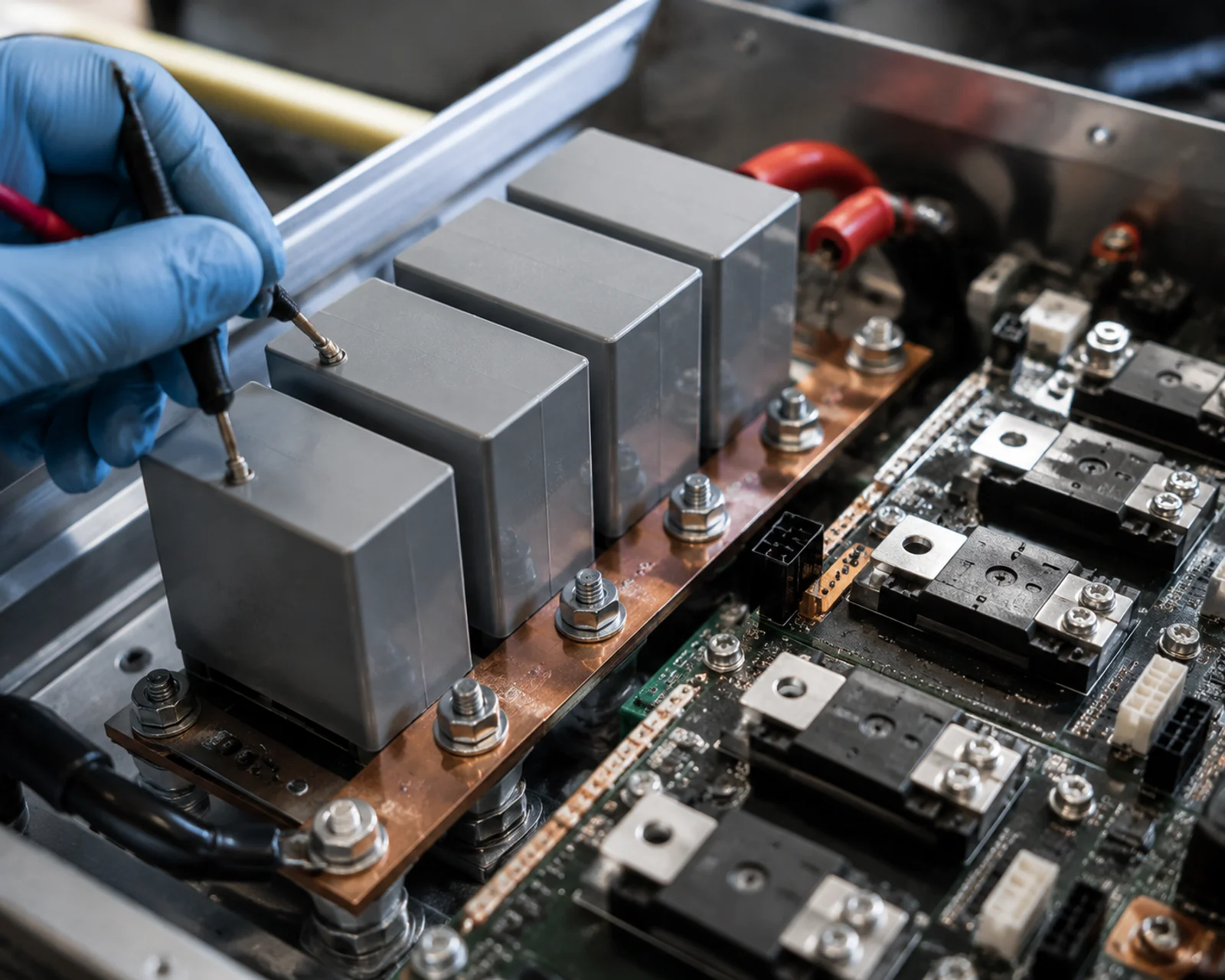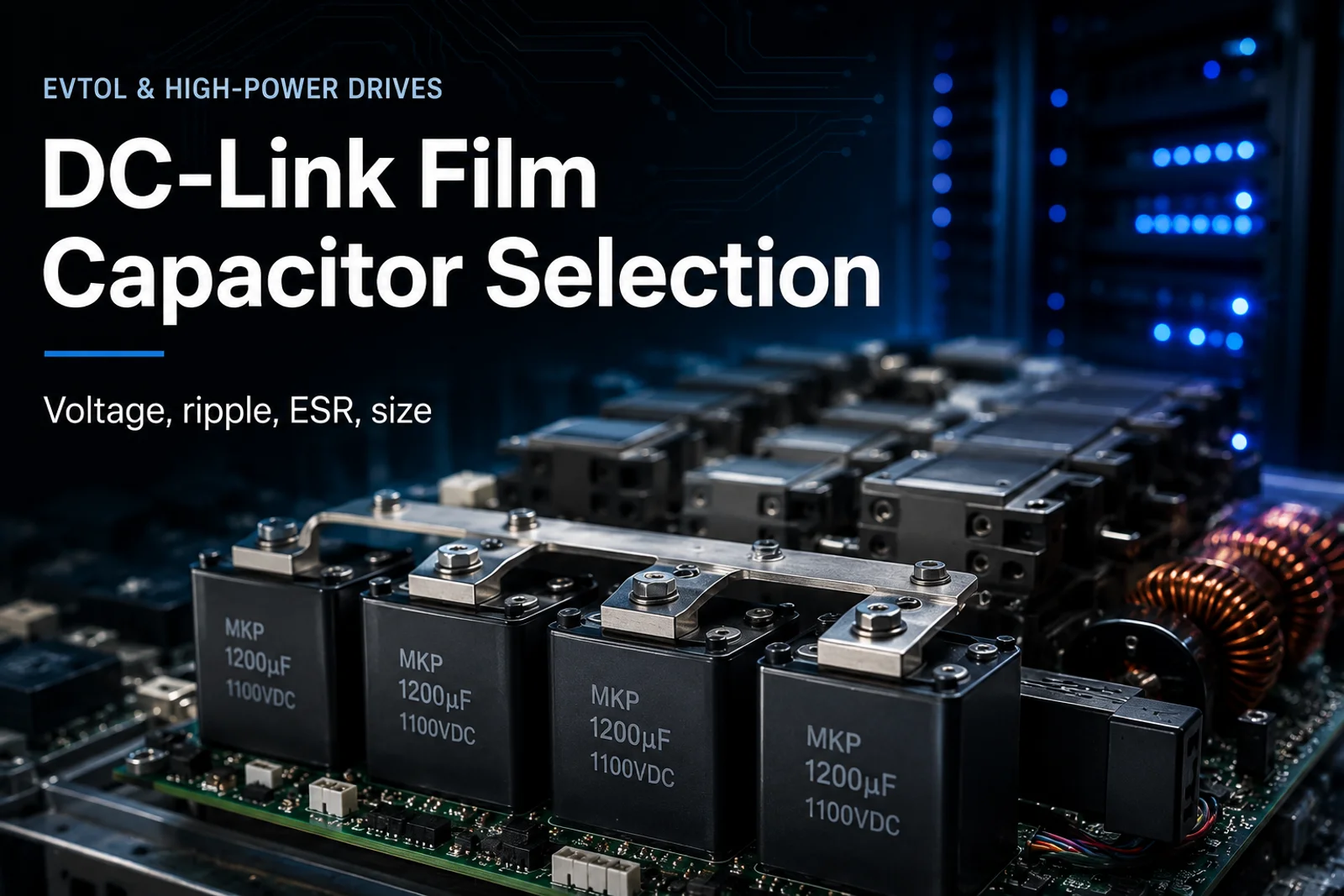
A solar inverter asks its DC-link capacitor for something harder than a peak rating. It asks for the same modest duty, repeated every day for twenty-five years. What separates a capacitor that reaches the end of the warranty from one that fails in year seven is usually the repetition rather than the headline voltage or current.
Most DC-link selection guides start with the bus voltage. For a solar inverter, the duty cycle comes first, because it sets the thermal budget the DC-link film capacitor has to live inside.
The Duty Cycle Comes First
A solar inverter starts with the sun and stops at dusk. Across one day its DC-link capacitor sees the bus voltage rise, hold through the middle hours, then fall away. Case temperature climbs, plateaus, then drops back overnight. On its own, none of that is severe. It becomes severe when it repeats every day.
Roughly nine thousand thermal cycles
Twenty-five years of daily cycling works out to about nine thousand thermal cycles, each one expanding and contracting the film, the metallization and every solder joint in the assembly. A capacitor specified only against its rated temperature will pass the first thousand without complaint. What it does at the end of the ninth thousand is the question a datasheet does not answer directly.
That reframes the exercise. Rather than asking whether the part survives its maximum ratings, ask how much of its life the daily cycle consumes, and whether the answer still leaves margin after the hottest week of the year.
What the DC Bus Voltage Sets
Bus voltage is the first hard constraint, and in solar it comes from the system architecture rather than from the inverter designer.
| System | Typical DC bus | What it means for the capacitor |
|---|---|---|
| Residential string | Up to 1000 V | Lower voltage class, but the tightest cost and space budget |
| Commercial and utility string | 1100 V or 1500 V | The mainstream case, and the one most new designs are written around |
| Central inverter | 1500 V | More power per unit, so more ripple current through each capacitor |
The capacitor is rated above the bus voltage, with headroom for switching overshoot and for the grid-side transients that reach back through the bridge. How much headroom is a design decision, and it trades directly against size and cost: a higher-rated film of the same capacitance is physically larger and more expensive.
Insulation coordination matters as much as the rating. In a 1500 V system the clearance and creepage distances inside the capacitor, and the way its terminals are potted, decide whether the part holds up under damp heat and pollution. A capacitor that meets its voltage rating on a bench test can still track across a contaminated surface in a field installation.
Ripple Current, Heat, and the Daily Cycle
Ripple current turns electrical stress into thermal stress, and thermal stress is what consumes life. In a solar inverter the ripple comes from two directions: the switching current of the inverter bridge, and the low-frequency component from the AC side.
The DC-link film capacitor has to absorb both. Its ESR converts that current into heat, the heat raises the hot spot above the case temperature, and the hot-spot temperature sets the rate at which the film degrades.
Why daily heat dose matters more than the peak hour
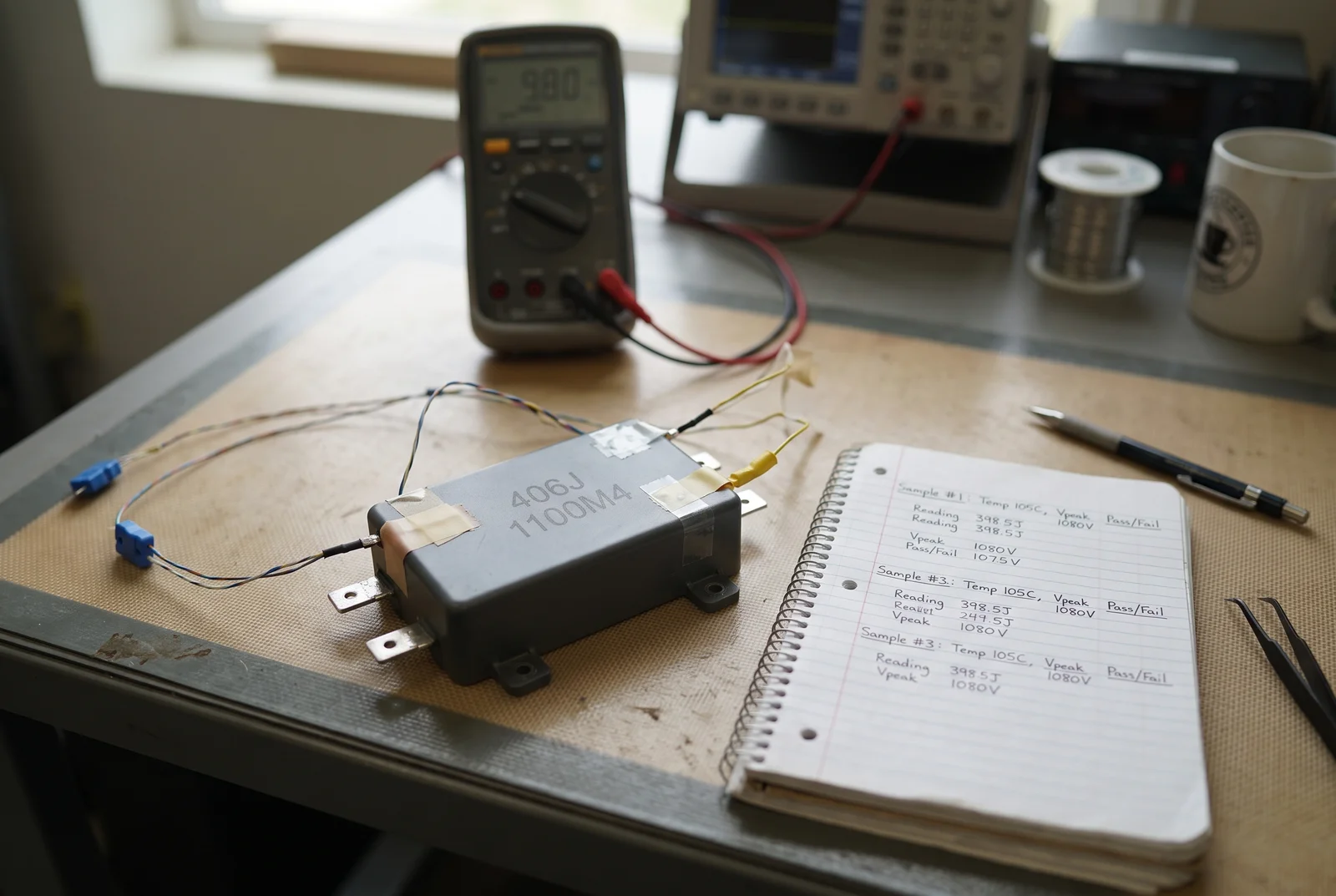
Designers often size against the peak ambient day of the year. The more useful number is the cumulative thermal dose across the whole day, because that is what the film actually accumulates. A capacitor that runs moderately hot for eight hours may age faster than one that runs very hot for one, and the baseline is set by the site’s daily average ambient rather than its record high.
Mounting matters for the same reason. A capacitor bolted to a heatsink, or to a busbar that carries heat away, runs cooler than one sitting in still air inside a sealed enclosure. The same part can have two very different service lives depending on where the inverter designer puts it.
Turning 25 Years Into a Specification
The lifetime figures in a film capacitor datasheet are quoted at a reference voltage and a reference hot-spot temperature. Moving to the real operating point is a two-part calculation: a voltage factor, and a temperature factor that follows an Arrhenius-type relationship, where every ten degrees of hot-spot reduction roughly doubles the expected life.
That rule is the most useful sizing lever in the whole design. Running a capacitor well below its rated voltage, and keeping its hot spot cool, buys life far more cheaply than specifying a larger can.
| Design choice | Effect on expected life | What it costs |
|---|---|---|
| Lower hot-spot temperature | Strong. Each 10 °C reduction is roughly a doubling | Layout, airflow or heatsinking |
| Operation below rated voltage | Meaningful, and it also shrinks the daily expansion cycle | A higher-rated part, which is larger |
| Lower ESR at the same capacitance | Indirect but real, through lower self-heating | Usually a larger film or a different metallization |
An inverter headed for a desert installation and one headed for northern Europe face the same 25-year target with very different ambient profiles. The capacitor that suits one may be over-specified or under-specified for the other, so work the numbers against the site rather than the catalogue. The same derating logic applies to higher-frequency designs, where faster switching changes what the capacitor sees.
Where Solar Installations Actually Fail
Field failures usually come from the interaction between the part and its environment rather than from a part that was under-rated on paper.
Moisture is the most common thread. A non-hermetic film capacitor absorbs water through its potting over years of damp heat, and the absorbed moisture raises dielectric loss and eventually supports corrosion of the metallization. Parts specified for high humidity and the right pollution degree survive it. Parts chosen on capacitance and voltage alone often do not.
Mechanical stress comes next. A large DC-link capacitor mounted on stiff busbars, inside a cabinet that expands and contracts daily, will see its terminals loaded in a way no datasheet test reproduces. Flexible connections and proper support belong in the capacitor specification rather than in the assembly notes.
Then there is the mismatch that shows up as a warranty claim: a bank of capacitors where one part runs measurably hotter than the rest because current sharing is uneven. The cool ones have margin to spare while the hot one consumes its life first.
Selection Checklist
Before quoting a part for a solar design, confirm the following.
Start with the DC bus voltage class, and the headroom the design allows above it, including switching overshoot. Then the worst-case continuous ripple current rather than the nominal figure. The hot-spot temperature deserves its own estimate: what the part will actually reach inside the enclosure, at the site’s daily average ambient. From those three you can work out expected life, with the voltage and temperature factors applied. Two more decide whether the part survives the field: the humidity and pollution degree the installation has to meet, and how the part is mounted, since the mounting decides whether heat leaves the part or stays with it.
If any of those is unknown at the quotation stage, say so. A capacitor quoted against a bus voltage alone is a guess, and in a 25-year application a guess is expensive to correct in the field.
FAQ
Why not use an electrolytic capacitor for the DC link in a solar inverter?
Some small inverters do. The difficulty is life. An electrolytic’s electrolyte dries out over time, and the rate depends on temperature in the same way film does, but from a much shorter starting point. In an application expected to run for 25 years in a hot enclosure, the film part is usually the one still meeting the target at the end.
Does a higher voltage rating always mean longer life?
It helps, but it is not free. A higher-rated film of the same capacitance is physically larger, which can make it harder to keep cool and harder to fit. The better question is whether the extra margin is buying life the design actually needs.
How do I know the hot-spot temperature before I have a prototype?
Estimate it from the ripple current, the ESR at the switching frequency, and the thermal resistance of the mounting. Then measure it on the first prototype at the highest expected ambient and correct the lifetime calculation. A datasheet curve on its own will not tell you where the inverter puts the part.
Xuansn supplies DC-link film capacitors for solar and energy storage inverters, and we quote against the duty cycle rather than the headline rating. Send your bus voltage, ripple current and expected hot-spot temperature to coco@xuanxcapacitors.com and we will come back with a part and a lifetime estimate.