What is a Robot Vacuum Capacitor?
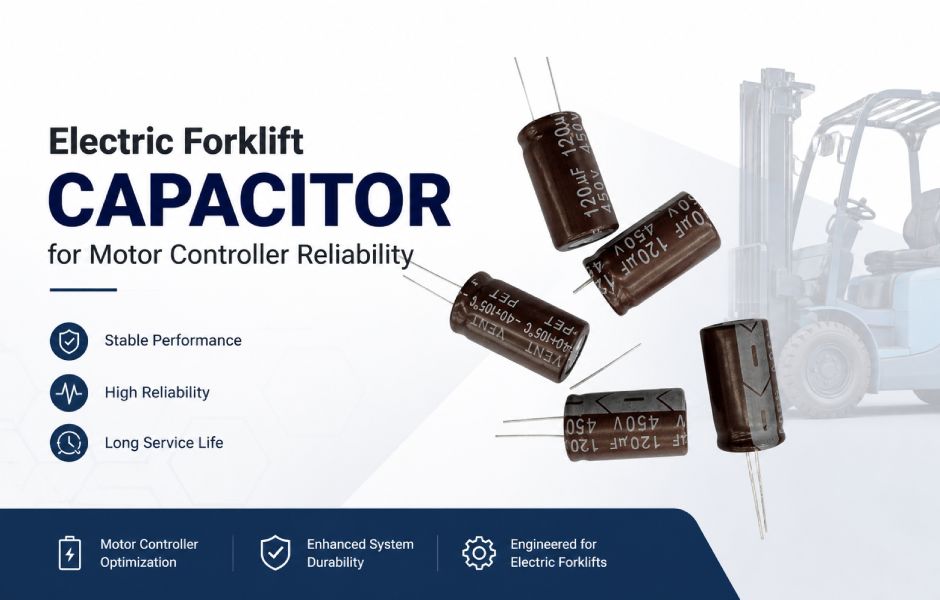
A Robot Vacuum Capacitor is a DC-Link aluminum electrolytic capacitor used in robot vacuum cleaner motor driver systems to stabilize DC bus voltage, absorb high-frequency ripple current, and provide transient energy support for BLDC motors.
It is typically placed between the rectifier and inverter stage in high-speed motor control systems.
👉 This component directly affects motor stability, suction consistency, and overall system reliability.
1. Role of Robot Vacuum Capacitor in BLDC Motor Drivers
In a typical robot vacuum motor drive system, the Robot Vacuum Capacitor is located at the DC-Link stage:
AC → Rectifier → Robot Vacuum Capacitors (DC-Link) → Inverter → BLDC Motor
Its main functions include:
1. DC-Link Voltage Stabilization
The Robot Vacuum Capacitor smooths DC bus fluctuations caused by high-frequency PWM switching.
2. Ripple Current Absorption
The Robot Vacuum Capacitor absorbs high-frequency ripple current generated by inverter switching circuits.
3. Transient Energy Support
During motor startup, blockage, or load change, the Robot Vacuum Capacitors provides instantaneous energy support.
Why Robot Vacuum Capacitor Is Critical in High-Speed Systems
In high-speed robot vacuum cleaner motor drive systems, the Robot Vacuum Capacitor plays a critical role in stabilizing the DC-Link voltage of BLDC motor drivers.
Modern robot vacuums typically operate under extremely demanding electrical conditions, including:
- BLDC motor speeds up to 200,000 RPM
- PWM switching frequencies in the range of 100 kHz to 300 kHz
At these operating conditions, the Robot Vacuum Capacitor is continuously subjected to:
- High-frequency ripple current generated by inverter switching
- Fast di/dt switching stress in the DC-Link circuit
- Continuous mechanical vibration from high-speed motor operation
As a result, the capacitor is no longer a passive filtering component but a key power stability element in the motor drive system.
👉 Therefore, standard aluminum electrolytic capacitors cannot maintain stable performance under these combined electrical, thermal, and mechanical stresses.
Electrical Characteristics of Robot Vacuum Capacitor
In high-frequency BLDC motor drive systems, a Robot Vacuum Capacitor does not behave like an ideal capacitor.
Instead, its electrical performance is determined by three internal physical effects:
- internal resistance (ESR)
- parasitic inductance (ESL)
- ideal capacitance behavior
Key insight: frequency-dependent behavior
The electrical behavior of a Robot Vacuum Capacitor changes depending on operating frequency:
- At low frequency:
The capacitor mainly acts as an energy storage component, providing stable DC-Link voltage support.
- At medium frequency:
Internal resistance (ESR) becomes dominant, causing noticeable power loss and heat generation.
- At very high frequency (PWM switching range):
Parasitic inductance (ESL) becomes the key factor, leading to voltage spikes and reduced filtering performance.
In modern robot vacuum cleaner motor drivers, where switching frequencies can reach 100 kHz to 300 kHz, the Robot Vacuum Capacitor operates far from ideal conditions.
👉 As a result, its performance is mainly limited by internal resistance and inductance rather than its nominal capacitance value.
This is why standard capacitors often fail in high-speed BLDC motor applications due to excessive heating, voltage instability, and reduced filtering capability.
Why Robot Vacuum Capacitors Fail?
Robot vacuum capacitors fail because they operate under a combination of extreme electrical, thermal, and mechanical stress conditions that exceed the design limits of standard aluminum electrolytic capacitors.
In modern robot vacuum cleaner systems using high-speed BLDC motors, the capacitor is exposed to high-frequency PWM switching, large ripple currents, and continuous vibration, which together accelerate degradation.
1. Electrical stress from high ripple current
In BLDC motor driver circuits, the Robot Vacuum Capacitor must continuously absorb high-frequency ripple current generated by inverter switching.
This causes internal power loss and heat accumulation, which gradually leads to:
- electrolyte evaporation
- capacitance reduction
- increased internal resistance
- thermal runaway in severe cases
👉 The higher the ripple current, the faster the capacitor ages.
2. High-frequency switching stress
Modern robot vacuums operate at PWM switching frequencies up to 100 kHz–300 kHz.
At these frequencies, the capacitor no longer behaves as an ideal energy storage device. Instead, parasitic effects inside the capacitor become dominant, leading to:
- voltage spikes across terminals
- reduced filtering efficiency
- increased electrical stress on internal components
👉 This makes the capacitor unstable under high-speed motor control conditions.
3. Mechanical vibration and shock
Robot vacuum cleaners operate in constantly moving environments with:
- high-speed motor vibration
- repeated start-stop cycles
- floor impact and structural resonance
These mechanical stresses cause:
- lead wire fatigue
- solder joint cracking
- internal winding displacement
👉 Mechanical failure is one of the most common long-term failure modes.
4. Inrush current and load shock
During motor startup, direction change, or blockage conditions, the capacitor experiences sudden high inrush current spikes (often exceeding 10A).
These repeated electrical shocks lead to:
- internal foil stress
- welding point degradation
- ESR drift over time
5. Design mismatch with compact systems
Robot vacuum cleaners require compact and lightweight PCB designs. However, standard capacitors often cannot simultaneously provide:
- high ripple current capability
- low ESR performance
- small physical size
- strong vibration resistance
👉 This mismatch leads to premature failure in real-world applications.
Conclusion
Robot vacuum capacitors fail primarily due to the combined effects of:
- high-frequency electrical stress
- excessive ripple current heating
- mechanical vibration fatigue
- transient surge currents
- and compact design limitations
In high-speed BLDC motor systems, a capacitor is no longer a simple passive component but a critical power stability element. If its ESR, ripple current rating, and mechanical structure are not properly designed, failure becomes inevitable.
Robot Vacuum Capacitor Solutions (LMM / LK / NPX Series)
To address the electrical and mechanical challenges in high-speed BLDC motor systems, Xuansn provides optimized Robot Vacuum Capacitor series specifically designed for robot vacuum cleaner motor driver applications.
Unlike standard capacitors, these series are engineered to operate under high-frequency switching, high ripple current stress, and continuous vibration conditions commonly found in modern robot vacuum systems.
Low ESR design for thermal stability
In Robot Vacuum Capacitor applications, excessive heat is mainly caused by power loss generated from high ripple current flowing through ESR.
By reducing ESR, the capacitor significantly lowers internal power dissipation, which helps:
- reduce temperature rise
- improve energy efficiency
- enhance long-term reliability
High ripple current capability for BLDC motor drive
Robot vacuum BLDC motor drivers operate under high-frequency PWM switching conditions, typically in the 100 kHz–300 kHz range.
The Robot Vacuum Capacitor must continuously absorb ripple current generated by the inverter stage.
Enhanced ripple current capability allows:
- stable DC-Link voltage support
- reduced voltage fluctuation
- improved motor control stability
Anti-vibration mechanical structure
Robot vacuum cleaners operate in continuously moving environments with high-speed motor vibration.
Mechanical reinforcement improves the reliability of the Robot Vacuum Capacitors by reducing:
- lead wire fatigue
- solder joint stress
- internal structural movement
This ensures stable electrical performance under long-term vibration conditions.
Compact design for high-density PCB layouts
Modern robot vacuum systems require compact motor driver boards with high power density.
A compact Robot Vacuum Capacitor design enables:
- better PCB space utilization
- improved thermal layout flexibility
- easier integration into slim device architectures
Engineering summary
The LMM, LK, and NPX series Robot Vacuum Capacitors are designed to solve three core challenges in BLDC motor driver systems:
- thermal stress from high ripple current
- electrical instability under high-frequency switching
- mechanical fatigue caused by vibration
👉 This makes them suitable for next-generation robot vacuum cleaner applications requiring high efficiency and high reliability.
Real Application Result in Robot Vacuum Motor Driver Systems
In a high-speed Robot Vacuum Capacitor application, standard aluminum electrolytic capacitors were replaced with optimized LMM/LK series capacitors in the DC-Link stage of a BLDC motor driver system.
The system operates under high-frequency PWM switching conditions and continuous vibration typical of robot vacuum cleaner environments.
Improved thermal performance (15–20°C temperature reduction)
After replacing the original capacitors, the Robot Vacuum Capacitor solution significantly reduced internal power loss caused by high ripple current.
This is primarily due to lower ESR, which reduces heat generation inside the DC-Link capacitor under high-frequency motor operation.
👉 As a result, the measured case temperature dropped by approximately 15–20°C under full load conditions.
Elimination of vibration-related failures
In the original design, mechanical vibration from the high-speed BLDC motor caused lead fatigue and intermittent electrical contact issues.
After adopting a reinforced Robot Vacuum Capacitor structure, mechanical stability was significantly improved, eliminating vibration-induced failures during long-term operation.
Improved motor drive stability
With optimized ripple current handling capability, the DC-Link voltage became more stable during rapid PWM switching.
This resulted in:
- reduced voltage fluctuation
- improved inverter control accuracy
- smoother motor operation
👉 The Robot Vacuum Capacitor directly contributed to more stable BLDC motor performance.
Stabilized suction performance
Because the motor driver system operates more consistently under load, the suction performance of the robot vacuum cleaner became more stable during real-world operation, especially under:
- filter blockage conditions
- rapid speed changes
- high-load cleaning scenarios