When choosing or replacing a capacitor, one of the most common questions is: what does uF mean on a capacitor?
The term uF (microfarad) represents a capacitor’s capacitance value — in other words, how much electrical energy the capacitor can temporarily store and release inside a circuit.
You’ll often see markings such as 1uF, 10uF, or 100uF printed directly on capacitors. Alongside uF, other units like nF, pF, and even the older marking MFD are also widely used in electronics.
Understanding these capacitor markings is essential for proper component selection, stable circuit performance, and reliable operation in power supplies, filtering systems, and signal-processing applications.
What Is uF on a Capacitor?
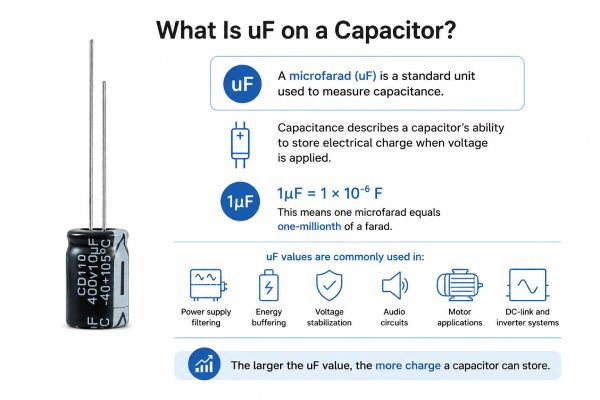
A microfarad (uF) is a standard unit used to measure capacitance.
Capacitance describes a capacitor’s ability to store electrical charge when voltage is applied.
Mathematically:
1μF = 1 × 10⁻⁶ F
This means one microfarad equals one-millionth of a farad.
In practical electronic circuits, uF values are considered relatively large and are commonly used in:
- Power supply filtering
- Energy buffering
- Voltage stabilization
- Audio circuits
- Motor applications
- DC-link and inverter systems
The larger the uF value, the more charge a capacitor can store.
Why the uF Value Matters
The capacitance rating directly affects how a circuit behaves. Selecting the wrong value may lead to unstable voltage, excessive ripple, or poor filtering performance.
A capacitor’s uF rating influences several key functions:
- Voltage smoothing — helps reduce ripple in power supplies
- Energy storage — supplies short bursts of current during load changes
- Signal filtering — suppresses noise and improves signal quality
- Timing control — determines delay and frequency characteristics in some circuits
Generally speaking, higher capacitance values provide stronger filtering and larger energy-storage capability.
uF vs nF vs pF Conversion
Capacitors use different capacitance units depending on the application and component size. The three most common units are:
| Value | Full Name | Value |
|---|---|---|
| 10⁻⁶ F | microfarad | uF |
| 10⁻⁹ F | nanofarad | nF |
| 10⁻¹² F | picofarad | pF |
uF, nF, and pF Conversion
1 uF=1000 nF=1,000,000 pF
This means:
- 1uF = 1000nF
- 1nF = 1000pF
- 1uF = 1,000,000pF
These conversions are commonly used when reading datasheets or replacing capacitors in electronic equipment.
Practical Capacitor Conversion Examples
Here are several common conversion examples engineers frequently encounter:
| Capacitance | Equivalent Values |
|---|---|
| 0.25uF | 250nF = 250,000pF |
| 0.01uF | 10nF = 10,000pF |
| 1nF | 0.001uF |
| 680pF | 0.68nF |
Using a quick conversion reference can help reduce mistakes during circuit design and maintenance.
What Does MFD Mean on a Capacitor?
If you work with older electronic equipment or HVAC systems, you may notice the marking MFD instead of uF.
MFD simply means microfarad.
In other words:
1 MFD=1 uF
There is no difference in capacitance value between MFD and uF.
Why Older Capacitors Use MFD
Years ago, manufacturers often avoided using the Greek symbol “µ” because it was difficult to print on small components. Instead, they used abbreviations such as:
- MFD
- MF
- uF
Today, uF has become the modern industry standard, while MFD mainly appears in:
- Air-conditioning systems
- Motor run capacitors
- Vintage electronics
- Industrial equipment
When replacing a capacitor, MFD and uF should always be treated as equivalent units.
How to Read Capacitor Values
Learning how to read capacitor markings is essential for choosing the correct component.
Depending on the capacitor type and size, values may appear as direct text or coded markings.
1. Direct Printed Markings
Large capacitors, especially electrolytic capacitors, usually display values directly.
Examples:
- 10uF 400V
- 100uF 25V
- 470uF 50V
In these markings:
- uF = capacitance
- V = maximum voltage rating
Always select a voltage rating equal to or higher than the actual operating voltage.
2. Understanding 3-Digit Capacitor Codes
Small ceramic capacitors often use a numeric code instead of full text.
Examples:
- 104
- 103
- 472
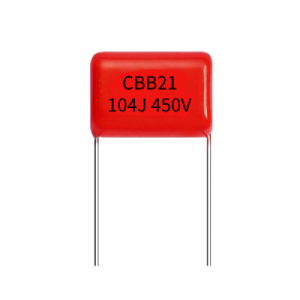
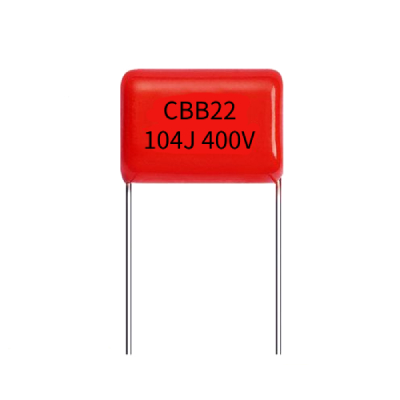
These codes are based on capacitance values in picofarads (pF).
3.How the 3-Digit Code Works
- First two digits → significant numbers
- Third digit → number of zeros added
Example calculations:
104 = 10 × 10³ pF = 100,000 pF = 100 nF
103 = 10 × 10² pF = 10,000 pF = 10 nF
This coding system saves space on miniature components.
Additional Capacitor Markings
Capacitors often include more than just capacitance values.
Other important specifications include:
| Marking | Meaning |
|---|---|
| 16V / 50V | Voltage rating |
| ±5% / ±10% | Tolerance |
| X7R / C0G | Temperature characteristics |
| Polarized stripe | Negative terminal indicator |
These parameters directly affect reliability, temperature stability, and circuit lifespan.
Common Mistakes When Reading Capacitors
Beginners frequently make errors when identifying capacitor values.
Typical issues include:
- Confusing uF, nF, and pF units
- Misreading 3-digit codes
- Ignoring voltage ratings
- Using polarized capacitors incorrectly
- Assuming all capacitors are interchangeable
Correct identification helps avoid overheating, circuit instability, and component failure.
Do Capacitors Have Polarity?
Some capacitors are polarized, while others are not.
Polarized Capacitors
Electrolytic capacitors usually have positive and negative terminals and must be installed correctly.
Non-Polarized Capacitors
Ceramic and film capacitors can generally be connected in either direction.
Understanding capacitor polarity is especially important in DC circuits and power electronics applications.
Quick Capacitor Value Reference
| Code / Value | Equivalent |
|---|---|
| 104 | 100nF |
| 103 | 10nF |
| 1uF | 1000nF |
| 0.1uF | 100nF |
This quick-reference chart is useful for troubleshooting, repairs, and capacitor replacement.
FAQ
Is a higher uF capacitor better?
Not necessarily. A higher uF value provides more capacitance, but using the wrong value may affect timing, filtering, or startup performance in electronic circuits.
Can I replace a capacitor with a different uF value?
It depends on the circuit. Small differences may work in some applications, but incorrect capacitance can cause instability or equipment damage.
Is MFD the same as uF on a capacitor?
Yes. MFD and uF both represent microfarads and are interchangeable in capacitor labeling.
What does 104 mean on a capacitor?
104 is a capacitor code meaning 100,000pF, which equals 100nF or 0.1uF.