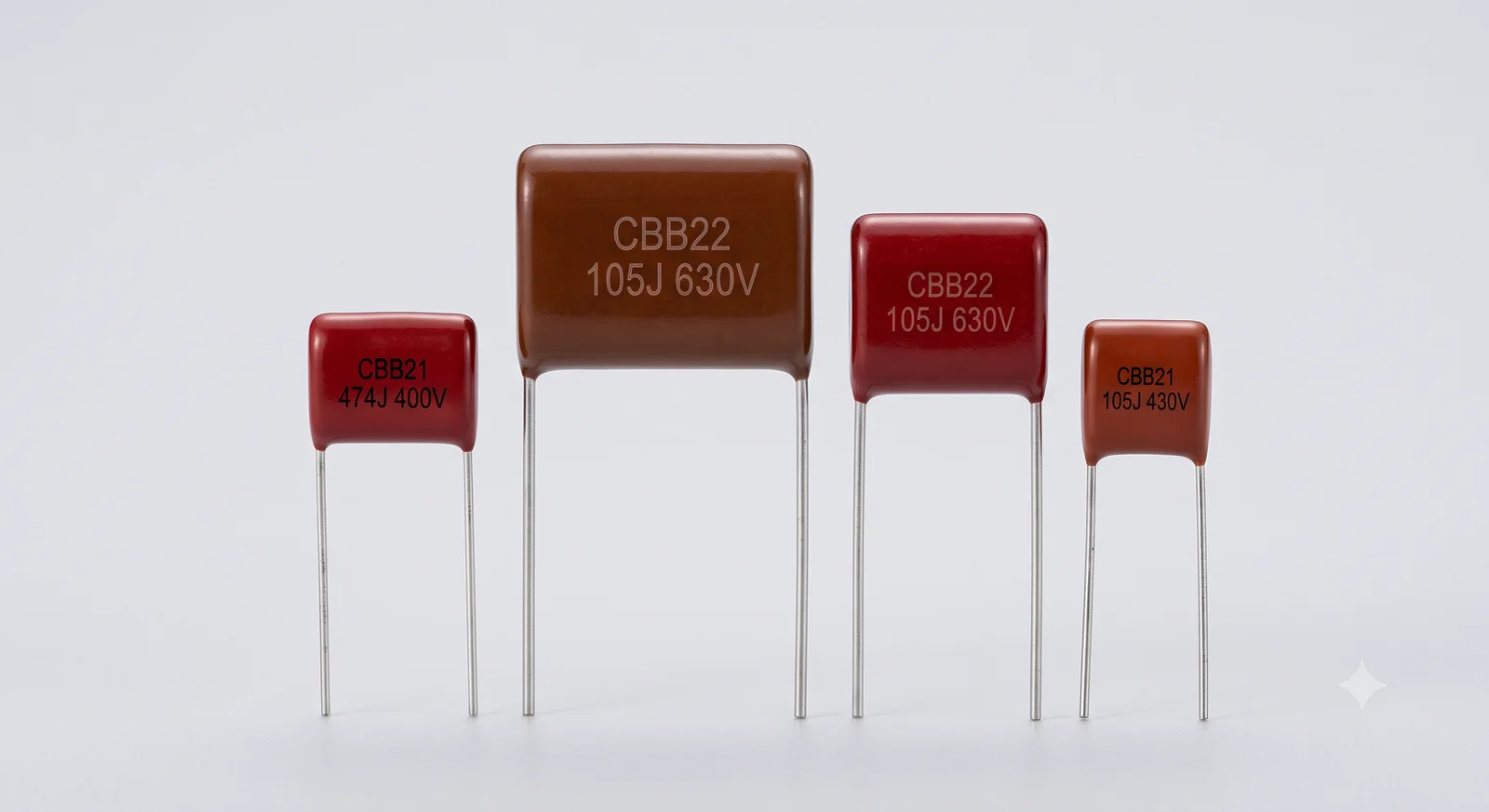
As artificial intelligence (AI) workloads continue to grow rapidly, modern data centers are increasingly dependent on high-performance computing infrastructure such as GPU clusters and AI training servers. In this environment, server capacitors for power supply systems have become a critical factor in 1U server PSU design, where extreme space constraints and thermal challenges directly impact power density, efficiency, and reliability.
Server capacitors play a vital role in energy storage, DC-link voltage stabilization, and high ripple current absorption. Their electrical and thermal performance directly determines the stability and efficiency of AI server power systems operating under high-frequency and high-load conditions.
This article provides a comprehensive engineering analysis of server capacitors used in AI power supply applications, focusing on high power density design, 105°C thermal reliability, and high-frequency switching environments driven by GaN and SiC technologies.
1. Challenges of Server Capacitors in 1U AI Power Supply Design
1.1 Extreme Space Constraints in 1U Server Architecture
In modern AI servers, the 1U form factor (44.45mm height) imposes strict limitations on internal component layout. As a result, power supply designers must achieve maximum performance within minimal physical volume.
In this environment, server capacitors for power supply systems must deliver:
- High capacitance density in extremely limited space
- Stable DC bus support for GPU and CPU transient loads
- Efficient layout integration without blocking airflow
The reduction of capacitor size often directly impacts thermal design, forcing engineers to carefully balance electrical performance and mechanical constraints.
1.2 High Temperature Operation in Data Center Environments
Inside compact server power modules, thermal density is extremely high due to:
- Dense PCB layout
- Limited airflow channels
- Continuous high-load AI computing operations
As a result, capacitors used in server power supply systems frequently operate at or near 105°C ambient temperature.
At this temperature level, conventional electrolytic capacitors face:
- Accelerated electrolyte evaporation
- ESR increase over time
- Reduced ripple current capability
- Shortened operational lifetime
Therefore, high-temperature endurance is a critical requirement for any server capacitor used in AI infrastructure and cloud computing systems.
1.3 High-Frequency Ripple Current from GaN and SiC Power Devices
Modern server power supplies increasingly adopt GaN (Gallium Nitride) and SiC (Silicon Carbide) semiconductor technologies to achieve higher switching efficiency.
However, these technologies significantly increase switching frequency, which leads to:
- Higher ripple current stress
- Increased internal heating in capacitors
- Greater demand on ESR stability
- More severe thermal cycling conditions
Thus, high ripple current capacitors for server power supply applications are essential for maintaining system stability in AI workloads.
2. Technical Requirements of High Power Density Server Capacitors
To meet the demands of AI data centers, modern server capacitors must satisfy several key electrical and thermal requirements.
2.1 High Capacitance Density for Energy Buffering
AI workloads such as machine learning training and inference produce rapid load fluctuations. Capacitors must provide sufficient energy storage to:
- Stabilize DC-link voltage
- Support sudden load spikes
- Prevent voltage droop in GPU power rails
This requires significantly improved capacitance density per unit volume, which is a core performance metric in modern capacitor design.
2.2 Ultra-Low ESR for Efficiency Optimization
Equivalent Series Resistance (ESR) directly affects power loss and thermal generation.
Low ESR enables:
- Reduced energy loss in switching cycles
- Lower heat generation inside capacitor body
- Improved overall PSU efficiency
In high-frequency GaN-based systems, ESR becomes one of the most critical parameters for server PSU capacitor selection.
2.3 High Ripple Current Handling Capability
Ripple current is one of the main stress factors in server power systems.
High-performance capacitors for server power supply must:
- Sustain continuous ripple current stress
- Avoid excessive self-heating
- Maintain stable electrical performance over time
This is essential for ensuring long-term reliability in data center environments.
3. Xuansn XTN Series: High Power Density Server Capacitors for AI Systems
The Xuansn XTN series aluminum electrolytic capacitors are designed specifically for next-generation AI server power systems, including high-density computing and GaN-based PSU architectures.
3.1 Ultra-High Power Density Design
In a compact 30 × 70 mm form factor, the XTN series achieves:
- 450V rated voltage
- 1400μF capacitance
- High-performance snap-in structure
With a capacitance density of 23.29 μF/cm³, the XTN series significantly improves space utilization in PSU design.
- System Benefits:
- Up to 55% reduction in power supply volume
- Improved airflow path design
- More efficient PCB thermal layout
This makes it ideal for 1U AI server power supply systems where space is extremely limited.
3.2 High Ripple Current Capability (19A Class Performance)
The XTN series supports up to 19A ripple current, enabling:
- Reduced need for parallel capacitor configurations
- Lower localized thermal accumulation
- Simplified power circuit design
This improves both electrical stability and system-level efficiency in high-load environments.
3.3 High Temperature Reliability at 105°C
Designed for continuous operation in harsh environments, the XTN series delivers:
- 3000 hours lifetime at 105°C
- Controlled capacitance degradation (≤8%)
- Stable ESR characteristics over time
This ensures long-term reliability in AI data centers and cloud computing infrastructure.
4. System-Level Impact: Server Capacitors in AI Data Center Power Systems
Modern AI infrastructure relies heavily on efficient power conversion systems. When integrated into GaN-based server power supplies, high-performance capacitors significantly improve system behavior.
4.1 Improved Power Efficiency
Lower ESR and optimized electrical behavior result in:
- 1%–2% improvement in PSU efficiency
- Reduced power loss during high-load operation
- 4.2 Reduced Thermal Stress
Better capacitor thermal performance leads to:
- ~10°C reduction in system temperature
- Increased thermal headroom for compact PSU design
- 4.3 Higher System Reliability (MTBF Improvement)
By reducing component count and simplifying DC-link design:
- Lower failure probability
- Improved long-term stability
- Higher MTBF in AI server environments
5. Applications of Server Capacitors
High-performance server capacitors are widely used in:
- AI training servers (GPU clusters)
- Cloud computing infrastructure
- Hyperscale data centers
- Telecom base station power systems
- High-efficiency industrial power supplies
- 1U / 2U server power supply units
These applications require extremely stable DC-link energy buffering and high ripple current endurance.
6. Conclusion: The Critical Role of Server Capacitors in AI Computing Infrastructure
In modern AI-driven computing systems, server capacitors are no longer simple passive components. They are fundamental building blocks that define the performance ceiling of power supply systems.
As data centers continue to evolve toward higher power density, smaller form factors, and greater efficiency, the demand for advanced capacitors for server power supply applications will continue to increase significantly.
Key challenges such as:
- Miniaturization
- Thermal reliability
- High ripple current handling
- High-frequency switching compatibility
require continuous innovation in capacitor materials, electrolyte systems, and structural design.
The Xuansn XTN series demonstrates how advanced aluminum electrolytic capacitor technology can successfully address these challenges, enabling next-generation AI server power systems with higher efficiency, smaller size, and improved reliability.
Ultimately, in the era of AI infrastructure, server capacitors are not just components—they are a core enabler of power density evolution in modern data centers.
[/fusion_text][/fusion_builder_column][/fusion_builder_row][/fusion_builder_container]