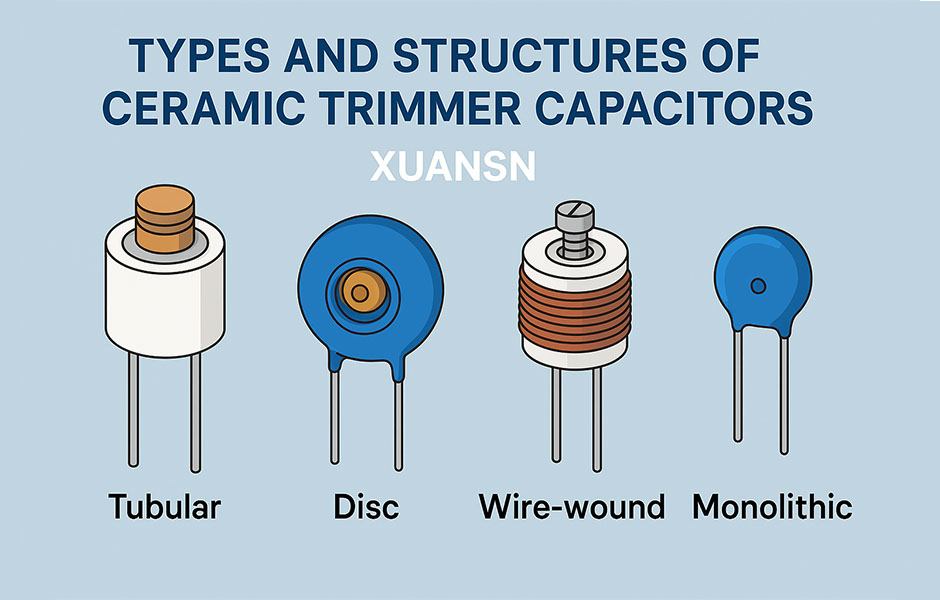
1.High-Power Ceramic Capacitor Structure Type
High-power ceramic capacitors refer to ceramic capacitors with a rated reactive power exceeding 200V·A. They use high-voltage, low-loss ceramic as the dielectric,Capacitor structure Type include various forms such as bottle-shaped, tubular, drum-shaped, and plate-shaped. They are used as tank circuit or coupling capacitors in high-power electronic and electrical equipment. XUANSN’s high-power ceramic capacitors offer advantages in performance and reliability.
1.1 Bottle-Shaped (Pot-Shaped) High-Power Ceramic Capacitors
Bottle-shaped high-power ceramic capacitors are the most common type of high-power ceramic capacitor. To improve the surface discharge voltage, the bottle mouth is made into a skirt-shaped concave flange. There are two lead types: with and without leads. The external structure is shown in Figure 1(a).
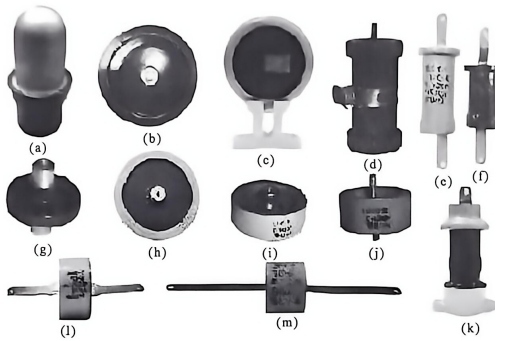
Figure 1 External Structures of Various High-Frequency Power Ceramic Capacitors
Those with leads have 12 series according to their structural dimensions and specifications, with outer diameters ranging from 30 to 74 mm and lengths from 60 to 135 mm. Capacitance up to 2200pF, rated DC operating voltage up to 8kV, rated high-frequency current up to 15A.
1.2 Cylinder High-Power Ceramic Capacitor
A cylindrical high-power ceramic capacitor is a type of capacitor with a circular structure, the capacitor structure type is cylindrical. Both ends of the ceramic cylinder have skirt-like flanges. The cylinder length is 168~235mm, and the diameter is 120mm. Rated DC operating voltage up to 30kV, rated high-frequency operating voltage up to 12kV, capacitance range 1000~6800pF, rated reactive power up to 80kV and above, and rated high-frequency operating current up to 40A. This type of capacitor is mainly used in tank circuits, coupling, filter networks, and feeder circuits. Its external structure is shown in Figure 3.1(k). XUANSN has mature technology in the production of this type of capacitor.
1.3 Plate-type High-Power Ceramic Capacitors
Plate-type high-power ceramic capacitors are circular plate capacitors. To improve surface discharge voltage, their insulating edges are made into rolled flanges. The diameter of the circular plate is 76~200mm, with a large capacitance range, up to 4700pF. The rated DC operating voltage can reach up to 15kV, and the rated high-frequency current can reach 20A. The external structure is shown in Figures 3.1(b), (c), (g)~(j), (1), and (m). Except for the plate-type power ceramic capacitor in Figure 3.1(g), which does not have rolled flanges on its insulating edges, the other plate-type capacitors all have rolled flanges.
1.4 Power Tubular Ceramic Capacitors
Power tubular ceramic capacitors have a similar capacitor structure type to general tubular ceramic capacitors, but differ in that the tube wall is thicker, the tube diameter is larger, the dielectric edge is larger, and the leads are plate-shaped. The external structure is shown in Figures 3.1(d)~(f). The ceramic tube diameter is 9mm or 19mm, and the tube length is 20~60mm. The capacitor is made of ceramic with high insulation strength and low loss. The rated DC operating voltage reaches 2.5kV, the capacitance range is 15~680pF, the reactive power reaches 1.2kV·A, and the rated high-frequency operating voltage reaches 1kV.
2.High Voltage Ceramic Capacitors
High voltage ceramic capacitors refer to ceramic capacitors with a rated DC operating voltage of not less than 1000V, but without specified requirements for reactive power.
2.1 Drum-Shaped High Voltage Ceramic Capacitors
Drum-shaped high voltage ceramic capacitors are a type of high-voltage dielectric capacitor using ferroelectric ceramic as the dielectric. Their capacitor structure type is drum-shaped. The structural feature is the use of metal bolt leads, extruded with nylon fiber or cast with epoxy resin to increase the surface discharge voltage. Its structure is similar to a cylinder.
The performance characteristics are large capacitance and high operating voltage. Rated DC operating voltage up to 30kV, capacitance range 470~10,000pF.
These capacitors are mainly used in radar, televisions, or other electronic and electrical equipment for bypassing, filtering, or voltage multiplication.
2.2 Disc Ceramic Capacitors
Disc high-voltage ceramic capacitors are structurally similar to disc ceramic capacitors, but differ in that they have a larger disc diameter, greater thickness, and a wider insulating edge between the two electrodes. Disc diameters include 8mm, 10mm, 12mm, 16mm, 20mm, and 24mm, with rated DC operating voltage up to 6.3kV. Class I capacitors have a capacitance range of 1~270pF and are suitable for ambient temperatures of -55~+125℃. Class II capacitors have a capacitance range of 330~22,000pF and are suitable for ambient temperatures of -40~+85℃.
3.Disc Ceramic Capacitors
3.1 Disc-Type UHF Ceramic Capacitors
The UHF disc ceramic capacitor has a disc-shaped capacitor structure type, short leads to reduce inductance and increase the capacitor’s resonant frequency. They can be used in ultra-shortwave electronic equipment operating at frequencies above 500MHz. There are two common external shapes. Modern UHF circuits almost universally use surface-mount packaging, which offers better performance than leaded ceramic capacitors due to the absence of leads and their associated parasitic inductance. Similar to disc-type ceramic capacitors, disc-type UHF ceramic capacitors are fading from use; therefore, their use should be avoided in UHF designs.
3.2 Disc-Type Ceramic Capacitors
Disc ceramic capacitors typically refer to low-voltage disc-type ceramic capacitors with a rated DC operating voltage of no more than 500V. They are the most produced type of ceramic capacitor. They mainly employ a monolithic structure, with lead configurations as shown in Figure 3.1. The disc ceramic capacitors have diameters of 4mm, 6mm, 8mm, 10mm, 12mm, 14mm, or 16mm. Their simple structure facilitates automated production, resulting in high output and low cost. With increasing mounting density, surface mount technology has become almost a standard in miniaturization and high-frequency circuit design, leading to the widespread use of surface mount packages for components. Disc ceramic capacitors below 50V are gradually being replaced by surface mount ceramic capacitors.
Whether for high or low frequencies, disc ceramic capacitors are currently only used in low-value and easily manufactured low-end electronic products.
4.Low-voltage ceramic capacitors
Just as there are high-voltage ceramic capacitors, there should also be low-voltage ceramic capacitors. Low-voltage ceramic capacitors refer to ceramic capacitors with a rated DC operating voltage below 1000V, and are currently the most commonly used type of ceramic capacitor. XUANSN also manufactures this type of ceramic capacitor to meet different application needs.
5.Feed-through ceramic capacitors
A feed-through ceramic capacitor is a bypass capacitor with a feed-through structure. Its capacitor structure type is a through-hole the internal electrode is made of copper rod (copper wire), that passes through the ceramic tube of the capacitor, with leads at both ends. The external electrode is led out using a threaded metal tube or metal sleeve. Its structure is shown in the figure. It is classified into Class I and Class II according to the dielectric material.
Class I feedthrough ceramic capacitors are available in ambient temperatures of -55~+85℃ and -55~+125℃, rated DC operating voltages of 160V and 500V, and capacitance ranges from 8.2 to 390pF.
Class II feedthrough ceramic capacitors are characterized by their small size and large capacitance. They are available in ambient temperatures of -55~+85℃ and -55~+125℃, capacitance ranges from 1000 to 10000pF, and rated DC operating voltages of 160V, 250V, and 500V.